Short answer
Yes. Once you hold a confirmed appointment, the scheduling portal will let you move it to any date currently available, including an earlier one. Nothing about the system forbids it, and rescheduling is not held against you in the visa decision.
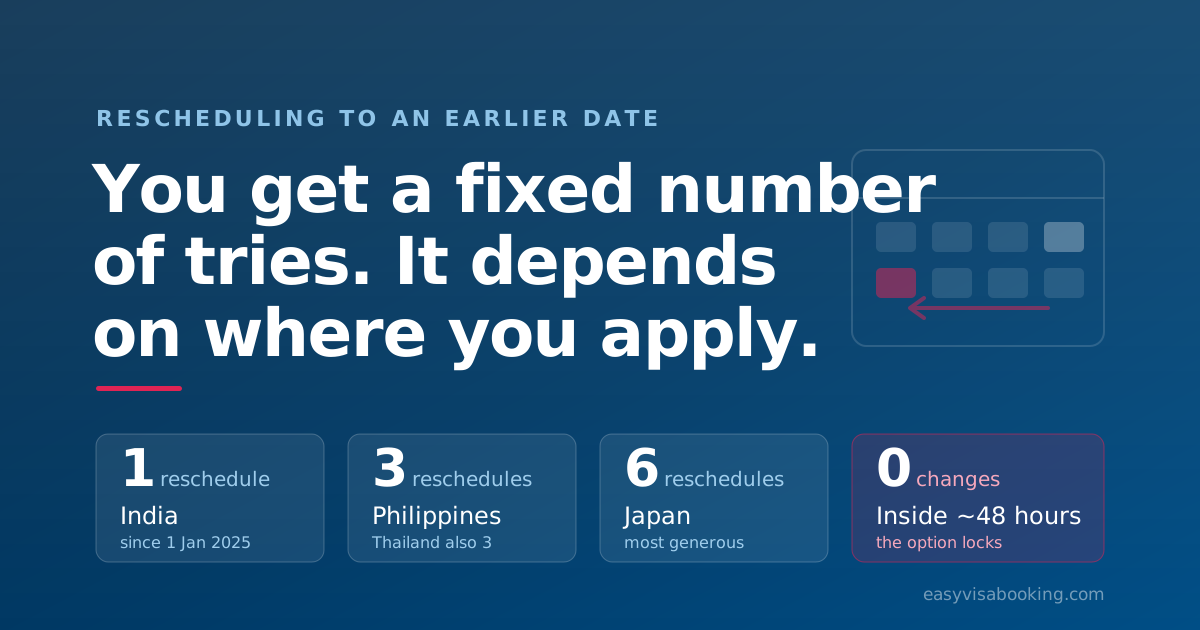
The real limits are two, and neither is obvious until you hit them. First, earlier dates only exist when somebody else gives one up, so availability is a matter of luck and timing rather than persistence. Second, you get a fixed number of changes per MRV fee, set by country: one in India since 1 January 2025, three in the Philippines and Thailand, six in Japan. Exhaust them and you must pay the $185 MRV fee again to regain the ability to move your date.
The rules that actually bind you
- Prerequisite
- You must already hold a confirmed appointment. No booking, no reschedule function.
- Attempts
- Set per country, per MRV fee. India 1 (since 1 Jan 2025), Philippines 3, Thailand 3, Japan 6
- If you run out
- A new MRV fee of US$185 for B-1/B-2 is required before you can change again
- Cut-off
- Changes typically lock ~48 hours before the appointment; act at least 3 business days ahead
- MRV validity
- One year from payment. Your interview must be scheduled within that window
- Effect on the decision
- None. Rescheduling is administrative and is not an adverse factor
The gate nobody explains: book first, then move
The most expensive misunderstanding in this whole process is also the simplest. People log in, see that the earliest available interview is eleven months away, decide that is unacceptable, and close the tab intending to check again next week for something better.
That decision costs them months, because the reschedule function only exists once you hold a confirmed appointment. Until you have booked something, there is nothing to reschedule, and the mechanism that produces earlier dates is simply not available to you. You are not "waiting for a better date". You are sitting outside the system that hands out better dates.
So the correct first move, in every case and without exception, is to book the earliest thing the portal will give you, however absurd the date looks. An interview eleven months out is not the outcome. It is the ticket that lets you start hunting for a better one, and a floor under you if the hunt fails.
Book something first. A distant appointment you can improve beats a perfect appointment you are not eligible to look for.
How many times can you reschedule?
Here is the part that determines your whole strategy, and the part almost nothing online states plainly: the allowance is set per country, it varies enormously, and it has been tightening.
There is no single global figure, because the scheduling platforms apply country-specific limits on how many changes you may make against one MRV fee. Applicant-reported figures for the systems most commonly asked about:
| Country | Reschedules allowed per MRV fee |
Notes |
|---|---|---|
| India | 1 | Cut from 3 to 1 on 1 January 2025. The portal warns you before you spend it: “You may only reschedule 1 more time.” |
| Philippines | 3 | Not counting the original booking |
| Thailand | 3 | Plus the initial appointment |
| Japan | 6 | The most generous allowance commonly reported |
| Everywhere else | Varies | Not centrally published. Read the warning text in your own portal before confirming any change |
Compiled from applicant reports (RedBus2US, August 2026). These limits are set by the scheduling platform per country and can change without announcement. Trust the message your own portal displays over any figure published anywhere, including this page.
The Indian change is the one that reshapes behaviour. Going from three attempts to one turns rescheduling from something you can experiment with into something you get exactly one shot at. If you are applying in India, do not spend your single reschedule on a date that is a few weeks better. Hold it for a date that meaningfully changes your position. As a rough rule, that means three months or more of improvement, or a date that actually rescues your trip.
The mistake this rule creates
Applicants who learned the process before 2025, or who read a guide written before then, still treat rescheduling as cheap and repeatable. It is not. Spending your one Indian attempt to move from June to May, and then watching a March slot appear a week later, is an entirely avoidable and entirely irreversible outcome. Check your remaining allowance before you click anything.
What happens when you run out
The portal stops you, and it is explicit about the consequence. The warning applicants see is along the lines of: if you cancel this appointment, you will have exceeded the limit of appointments cancelled and will not be able to schedule another until a new MRV fee is paid.
In practical terms:
- Your existing appointment normally stays valid. You have not lost your interview; you have lost the ability to move it.
- Regaining that ability means a new MRV fee. US$185 again for a B-1/B-2 applicant. It is not a penalty fee; it is a fresh application fee, and it starts a new one-year validity window.
- The old fee is not refunded. MRV fees are non-refundable in all circumstances.
Which means the honest framing of your reschedule allowance is that each attempt is worth roughly $185 divided by the number you were given. In India, one attempt, that is the entire $185. Treat it accordingly.
The timing rules that lock you out
Two deadlines catch people who leave it late.
The 48-hour lock. Changes are typically frozen in the roughly two days before your scheduled interview. Once inside that window the reschedule option stops functioning entirely. There is nothing to appeal to and no support ticket that reopens it.
The three-business-day practice. If you need to cancel or move, doing it at least three business days ahead is the safer margin. Beyond the lock itself, leaving changes to the final moments risks account restrictions in some systems, and the difference between a controlled change and a scramble is usually just planning a few days earlier.
There is a third clock behind both: your MRV receipt is valid for one year from payment, and your interview must fall inside that window. Applicants who spend eight months hunting for a better date sometimes discover the real deadline was never the wait. It was their own fee expiring.
Where earlier dates actually come from
Understanding the supply side removes most of the frustration, because it explains why the calendar behaves the way it does.
Earlier appointments come from exactly two places. Cancellations and reschedules by other applicants, where someone gives up a slot in three weeks and it returns to the pool, and new capacity released by the post, which happens in batches on no published schedule.
Both have the same consequence for you: availability is a moment, not a state. A slot returned to the pool is visible to every applicant watching that calendar simultaneously, and in a high-demand market it is claimed in seconds. This is why the calendar looks permanently empty to someone checking once a day, and why the same calendar produces earlier dates for someone looking at the right instant. Nothing is hidden. You are simply sampling a fast-moving system infrequently.
It also explains why no honest provider will promise you a date. The supply is generated by other people's decisions.
On the question of a "best time" to look: there is no published release schedule, and any specific hour presented as an insider secret is folklore. What can be said is that cancellations follow ordinary human behaviour. They cluster during the consulate's local working hours and around the points where other applicants hit their own cancellation deadlines. Varying when you check beats fixing on one time.
Five mistakes that waste an attempt
- Cancelling instead of rescheduling. Use the reschedule function so that the change is atomic: the old appointment is replaced by the new one. Cancel first and you are holding nothing while you search, and slots do not wait.
- Spending an attempt on a marginal gain. Especially with one attempt in hand. Set a threshold before you start looking and hold to it.
- Not having the paperwork ready. When a slot appears you have seconds. A DS-160 that is incomplete, a fee not yet processed, a profile missing details: any of these turns a found slot into a lost one.
- Checking only one location. Waits differ dramatically between posts in the same country. Our Canada guide works through this: Toronto is consistently the hardest post in the country while Halifax and Quebec City are consistently easier, and a domestic flight costs less than a six-month delay.
- Refreshing obsessively and calling it strategy. Hammering the portal does not increase supply, and some systems respond to unusual request volume with temporary restrictions on the account. Sensible, spaced checks at varied times of day are more effective and carry no risk.
Before you spend an attempt, check whether you have a better route. If you have a documented emergency you may qualify for a free expedited appointment request, and if you are applying in Mexico or Canada there is now a paid government fast lane. Both are covered in our guide to the $750 expedited appointment pilot, and for Canadian posts in the $750 paid expedite in Canada.
What to do when the calendar is empty
An empty calendar is the single most common complaint, and it is almost always exactly what it looks like: no unclaimed slots at that instant. Before assuming something is broken, work through the four causes in order.
- There genuinely are none right now. Check again at a different time of day. The calendar is a snapshot of an unclaimed pool, not a schedule.
- You have exhausted your reschedule allowance. The option disappears or errors. Check your remaining count.
- You are inside the lock window. Within roughly 48 hours of your appointment, changes are frozen.
- Your application is not in a state that permits scheduling. An incomplete DS-160 or an unprocessed MRV payment will block the function.
If none of those apply and the portal itself is misbehaving, that is a separate problem. Wait and retry rather than repeatedly submitting, which is the behaviour most likely to attract a temporary restriction.
Doing it yourself versus paying someone
Rescheduling is genuinely doable alone. The question is only whether the pattern of attention it requires fits your life.
Ways to work the reschedule, compared
Costs exclude the US$185 MRV fee, which everybody pays to the US government regardless. Third-party pricing changes, so verify with each provider directly.
| Approach | Cost | What it asks of you | Works well when |
|---|---|---|---|
| Check the portal yourself | Free | Log in at varied times through the day, every day, ready to act in seconds. | Your schedule is flexible and your deadline is soft |
| Slot-availability websites e.g. CheckVisaSlots, VisaGrader |
Free tier; paid alert plans, billed whether or not a date appears | Set up alerts, then still be free to log in and claim the slot yourself the moment one lands, at whatever hour that is. | You can genuinely drop what you are doing on a notification |
| All-in-one visa platforms | Service fee charged at checkout, before any date changes | Run your whole application through their platform. | You want the DS-160 and documents handled too, not just the date |
| $750 government expedite | $750 per applicant | Request it at a participating post: US posts in Mexico and, since 18 August 2026, Canada. | You are in Mexico or Canada, on B-1/B-2, with a hard deadline |
| Easy Visa Booking us | From $100, paid only on success | Tell us your consulate, category and deadline. Our team takes the rescheduling work on and helps you move to an earlier date. | Your wait is months, your deadline is real, and work or study makes watching a portal unrealistic |
Third-party services are named because they are the alternatives you are already comparing, not as endorsements. We have no commercial relationship with any of them, and every description above is of their published model, not a criticism of how they run it.
Where we are different from every other row in that table
- You pay only if the date actually moves. Our fee starts at $100 and is charged when an earlier interview is secured, not before. An alert plan bills you for the notification whether or not a date ever comes. The $750 government route is paid up front. An all-in-one platform takes its fee at checkout. We are the only row where a result you did not get costs you nothing.
- The watching is our job, not yours. Every free and alert-based route above ends the same way: you, logged in, acting within seconds, at whatever hour the opening lands. Our team carries the rescheduling work instead, so your working day is not organised around a calendar you cannot control.
- A wide date range is the biggest lever you control. If you can accept any date inside a broad window rather than one specific morning, the odds of moving your interview go up sharply. Tell us the widest range your travel plans allow and we will tell you honestly how it looks before you commit to anything.
- We do one job rather than bundling four. We work rescheduling to an earlier date. You are not paying a packaged fee for DS-160 form help you have already done yourself.
- The limits are published before you pay. Named founder, real support channels, terms and a refund policy you can read first, and a plain statement that nobody can guarantee a date. Compare that with the anonymous accounts working the same search results.
Every claim in this box is checkable on this site before you speak to anyone here. That is the point of listing them.
The honest test is the one below the fee. If your wait is a few weeks and your dates flex, do it yourself. You will succeed and you should keep your money. If your wait is many months, your deadline is fixed, and you cannot realistically watch a calendar through a working day, that is where paying somebody stops being laziness and starts being arithmetic.
Whichever route you choose, apply the checks in our guide to whether slot booking services are legit before you pay anyone. That article runs the same seven tests on us that it asks you to run on everyone else.
Frequently asked questions
Can you reschedule a US visa appointment to an earlier date?
Yes. Once you hold a confirmed interview appointment, the scheduling portal lets you move it to any date that is currently available, earlier ones included. The constraint is not permission but supply and allowance: earlier dates exist only when another applicant cancels or the post releases capacity, and each country limits how many times you may change your appointment per MRV fee paid.
How many times can you reschedule a US visa appointment?
It depends entirely on where you are applying, and the numbers are not published in one place. Applicant reports indicate India allows one reschedule since a rule change on 1 January 2025, reduced from three. The Philippines and Thailand allow three, and Japan allows six. Always trust the warning message your own portal displays over any figure published elsewhere, including this page.
What happens when you run out of reschedules?
The portal blocks further changes and warns that you will be unable to schedule another appointment until a new MRV fee is paid. For a B-1/B-2 applicant that means paying US$185 again to regain the ability to change your date. Your existing confirmed appointment normally remains valid; you simply lose the ability to move it.
How close to my appointment can I still reschedule?
Changes typically lock roughly 48 hours before your scheduled interview, and the safer practice is to make any change at least three business days ahead. Leaving a cancellation or change to the last minute risks both the lockout and, in some systems, an account restriction.
Why can I not see any earlier dates in the portal?
Almost always because there genuinely are none at that moment. The calendar shows only what is currently unclaimed, and earlier slots appear when other applicants cancel or reschedule, then disappear within seconds. An empty calendar is a snapshot, not a verdict. Other causes are having exhausted your reschedule allowance, being inside the pre-appointment lock window, or an incomplete DS-160 or unpaid MRV fee.
Will rescheduling cancel or endanger my existing appointment?
A completed reschedule replaces your existing appointment with the new one; you never hold both. The genuine risk is cancelling first and then trying to book, which leaves you holding nothing if the slot you wanted is taken in the interval. Use the reschedule function rather than cancel-then-rebook, and confirm the new appointment letter before you consider it done.
Does rescheduling affect my visa approval chances?
No. Changing your interview date is an administrative scheduling action. It is not recorded against you as an adverse factor and consular officers do not adjudicate on how many times an applicant changed a date. Approval turns on your eligibility and evidence at the interview.
Is there a best time of day to look for earlier US visa slots?
There is no published release schedule, and any specific time presented as a secret is folklore. What is true is that cancellations cluster around ordinary human behaviour: during consulate working hours in the local time zone, and around the point where other applicants hit their own cancellation deadlines. Checking at varied times beats checking at one fixed time.
The bottom line
You can move a US visa appointment earlier, and rescheduling is the mechanism that does it. But it is a finite resource, not an unlimited one, and since January 2025 applicants in India have had exactly one attempt to spend.
So the strategy is short enough to remember: book something immediately, find out how many attempts your country gives you, decide in advance what improvement is worth spending one on, keep your paperwork ready so you can move in seconds, and never let the change slip inside the 48-hour lock.
What nobody can promise you
Earlier dates come from other applicants cancelling. Nobody outside the US government controls that supply, which is why no service, ours included, can guarantee you an earlier date, a timeframe, or a visa. Anyone offering that guarantee is describing something they do not control.
Sources
- RedBus2US, “How many times can I reschedule my US Visa Appointment?”. Country-by-country limits and portal warning text. Retrieved 12 August 2026.
- US Department of State, Global Visa Wait Times. Current interview waits by post. Retrieved 12 August 2026.
Published 12 August 2026. Reschedule allowances are set by the scheduling platform per country and can change without announcement, so always confirm against the message shown in your own portal. This article is general information and is not legal or immigration advice.
One attempt, and a deadline you cannot move?
That is the case where spending your reschedule badly costs the most. If you cannot watch the calendar through a working day, our team can take that on.
- From $100, and you pay only if we secure you an earlier date
- The wider the date range you can accept, the more often we can move it
- No guarantee of a date, stated plainly before you decide anything
Easy Visa Booking is an independent scheduling assistance service, not affiliated with the US Department of State, any US Embassy or Consulate, CGI Federal or the AIS portal. All appointments are made through the official portal.