Short answer
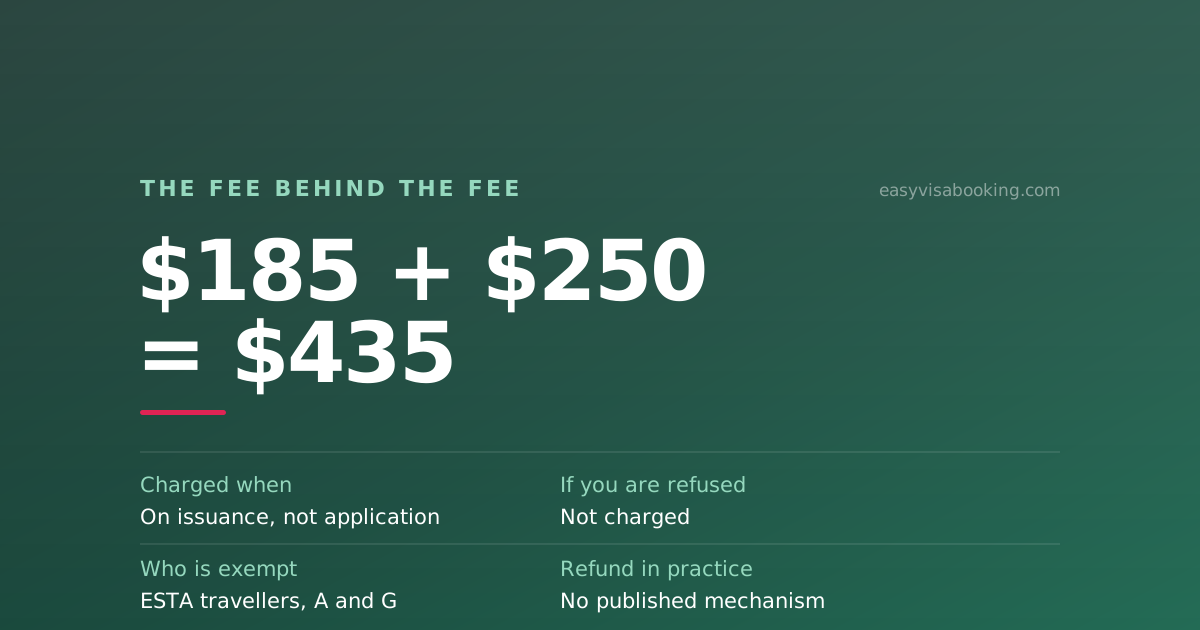
The visa integrity fee is $250, it is charged when your visa is issued rather than when you apply, and it takes the real cost of a US visitor visa from $185 to $435 per person. It was created by the One Big Beautiful Bill Act of 4 July 2025, it covers almost every nonimmigrant category including dependants, and you are not charged it if you are refused. Collection is still uneven across consulates, so whether you pay it today depends on your post.
At a glance
- Amount
- $250 base, rising annually with inflation from fiscal year 2026
- Charged when
- On visa issuance, after approval, not at application
- If you are refused
- Not charged. The $185 MRV fee is still gone
- Who pays
- Almost every nonimmigrant category, dependants included
- Who does not
- ESTA travellers under the Visa Waiver Program, and diplomatic categories
- Legal basis
- One Big Beautiful Bill Act, Public Law 119-21, signed 4 July 2025
- In force from
- 1 October 2025, but collection has rolled out post by post
- Refundable
- In statute yes, in practice no. No claim mechanism has been published
What the fee is, and where it came from
Almost every article about US visa costs still quotes one number, $185, and stops. That number has been incomplete since the middle of 2025 and the gap is now $250 a head.
The One Big Beautiful Bill Act, signed on 4 July 2025 as Public Law 119-21, created a visa integrity fee. The mechanics that matter:
- $250 is the base, not the ceiling. The Department of Homeland Security can set it higher by regulation, and from fiscal year 2026 it rises annually with the Consumer Price Index. It is designed to drift upwards.
- It is charged at issuance. The State Department collects it when your visa is actually issued, which is after the interview and after approval. That is a genuinely different point in the process from every other fee you have paid.
- It applies per person, across almost every category. B-1/B-2, F-1, H-1B, L-1, O-1, TN and the rest, and it reaches dependants too: an H-4 spouse, an L-2 child and an F-2 dependant each owe their own $250.
- It is additional. It does not replace the MRV application fee, the SEVIS fee for students, or any reciprocity fee your nationality attracts.
One thing about it is unambiguously good for applicants, and it is worth saying plainly because most coverage of this fee is uniformly negative. Because it lands at issuance, a refused applicant does not pay it. That is the opposite of how the MRV fee works, and in a process where refusal is common it matters.
What a US visa actually costs now
Two numbers, in the order you meet them: the application fee before your interview, and the integrity fee after it.
| Visa | MRV application fee | Integrity fee | Total per applicant |
|---|---|---|---|
| B-1/B-2 visitor | $185 | $250 | $435 |
| F-1 / M-1 student | $185, plus the SEVIS I-901 fee | $250 | $435 before SEVIS |
| J-1 exchange visitor | $185, plus the SEVIS I-901 fee | $250 | $435 before SEVIS |
| H, L, O, P, Q, R petition-based | $205 | $250 | $455 |
| K fiance | $265 | $250 | $515 |
| E treaty trader or investor | $315 | $250 | $565 |
| Visa Waiver Program (ESTA) | No MRV fee | Exempt | $40.27 ESTA fee |
MRV tiers from the State Department's published fee schedule; integrity fee amount from the One Big Beautiful Bill Act. Retrieved 19 August 2026. Some nationalities also owe a visa issuance or reciprocity fee, which is set by the arrangement between the United States and your country and is not included above. Verify both against the official fee page before you budget.
The arithmetic that catches families out: none of it is per household. Four B-1/B-2 applicants are $740 in application fees and $1,000 in integrity fees, so $1,740 before a single flight, document or photograph. Where the old figure of $185 each made a family application feel like a manageable $740, the true number is more than double that.
This makes our own comparison tables out of date
Every cost comparison on this site, including the one further down this page, has carried the line "costs exclude the US$185 MRV application fee, which everybody pays to the US government regardless". That was true when it was written and it is incomplete now. If you read one of our older guides and budgeted $185, we undercounted for you, and the honest thing is to say so on the page where the correct number lives rather than quietly editing the others. We are working through them.
Is it being charged yet? The honest answer
This is the question every applicant actually has, and it is the one almost no page answers straight, because the straight answer is uncomfortable: it depends which consulate you are dealing with.
The statutory start was 1 October 2025, the beginning of fiscal year 2026. What followed was not a single switch-on. Practitioner reporting through the first half of 2026 describes an uneven rollout, with some posts actively collecting the fee while others were still waiting for payment and tracking systems to go live. University international offices, which see large volumes of student cases across many posts and have no reason to overstate any of this, were reporting in May 2026 that some posts had begun charging it while others had not.
So the practical position in the second half of 2026:
- Budget the full $435. If you are not charged, you are $250 better off than planned. Planning the other way round is how a trip gets cancelled at the last step.
- Take your instructions from your own post, at the time. Not from an article, this one included, and not from a forum thread about a different country. The consulate issuing your visa is the only authority on what it will charge you.
- Keep proof of payment. If a refund mechanism ever appears, the people who kept a receipt will be the only ones able to use it.
- Pay it only where the post tells you to. A new fee with an inconsistent rollout is an unusually good cover story for fraud. See the warning below.
The fee is a scam vector, and a good one
Think about what this fee looks like from a fraudster's point of view. It is real, it is widely reported, it is genuinely charged at some posts and not others, and it is payable at an unusual point in the process. That combination means a demand for $250 arriving by email or message is both plausible and hard for an applicant to check. Nobody outside the US government collects this fee. It is not paid to an agent, not to a personal bank account, not through a payment link in a message, and not to anyone offering to "clear" it for you. If a demand does not come from your own consular process, it is not the integrity fee.
The refund almost nobody will collect
The statute does allow the fee to come back to you. The conditions are that you do not work without authorisation and that you either leave within five days of your authorised stay ending or obtain a lawful extension or change of status.
Read that in the real world and the picture changes.
- There is no way to claim it. No portal, no form and no published instructions have appeared from the Department of Homeland Security or the State Department. A right with no mechanism is not a right you can exercise.
- The clock is very long. A ten-year B-1/B-2 means the earliest a claim could even arise is a decade after payment, on the basis of compliance evidence you would have to have kept for that whole period.
- The compliance bar is exacting. Five days is a narrow window, and proving a clean record of it years later is a documentation problem most travellers will not have solved.
Our advice is unglamorous and we would rather give it than a hopeful one: treat the $250 as spent. Keep the receipt, because it costs nothing to keep, but do not build any part of a travel budget on getting it back.
Who does not pay it
Two groups are outside the fee, and one of them is larger than people realise.
Visa Waiver Program travellers
If your nationality lets you travel on an ESTA rather than a visa, the integrity fee does not touch you. The ESTA itself did get more expensive: it rose from $21 to $40 for applications filed on or after 30 September 2025, and an inflation adjustment took it to $40.27 in January 2026. That is still an order of magnitude below $435, and it is the single biggest cost difference between the two routes into the United States.
Diplomatic and official categories
A and G visa categories, and a small number of related classifications, sit outside it. For anybody reading this page that is unlikely to be the relevant exemption.
Everyone else is in scope, and the point worth repeating is that it reaches dependants. An H-1B worker moving a spouse and two children is looking at four integrity fees, not one.
No fee here buys you a faster interview
Because the integrity fee arrived at the same time as a genuine paid fast lane, the two get confused constantly, and the confusion costs people money. They are unrelated.
| Fee | What it does | Effect on your interview date |
|---|---|---|
| $185 MRV application fee | Lets you schedule an interview at all | None. It buys access to the calendar, not a place in it |
| $250 visa integrity fee | Charged on issuance, after the decision | None whatsoever |
| $750 expedited appointment | The State Department's pilot: an interview within 10 business days | Real, but only for B-1/B-2 applicants at Mission Mexico or Mission Canada, and only while a paid slot is open |
Participating posts for the expedite pilot as listed by the State Department on 19 August 2026. The pilot is scheduled to close on 31 December 2026.
Applying in Mexico or Canada with a hard deadline? The $750 lane is the one fee on this page that genuinely changes a date, and it is worth understanding before you spend it. Read who qualifies for the $750 expedited appointment.
What this changes about paying anyone
Here is the part that works against us, and we would rather write it than have you work it out afterwards. Every dollar the government adds makes a paid service harder to justify. A reader who was weighing $100 against a $185 government cost is now weighing it against $435, and for some of you that arithmetic should end with you keeping your money.
So look at the whole set, including the free rows, with the real government total sitting underneath all of them.
What each route to an earlier date actually costs you
Costs below are on top of the US government fees everybody pays: the MRV application fee, and the $250 visa integrity fee where your post is collecting it. Third-party pricing changes, so verify with each provider directly.
| Option | Cost | When you pay | Best suited to |
|---|---|---|---|
| Do it yourself | Free | Never | Flexible dates, a soft deadline |
| Expedite request to the consulate | Free | Never | Documented emergencies, one credible attempt |
| Slot-availability websites | Free tier; paid alert plans | Monthly, whether or not a date appears | Applicants who can act within seconds |
| All-in-one visa platforms | Service fee | At checkout, before anything changes | First-time applicants wanting everything handled |
| $750 government paid expedite | $750 per applicant | Up front, non-refundable, at participating posts only | B-1/B-2 with a hard deadline in Mexico or Canada |
| Easy Visa Booking us | From $100, paid only on success | After an earlier date is secured, and only then | Long waits, a fixed deadline, and no time to watch a portal |
The categories above are the alternatives you are already comparing, not endorsements. We have no commercial relationship with any provider in them, and pricing models change, so verify current terms directly.
What our row gives you that the ones above it do not
- You pay only if the date actually moves. From $100, charged when an earlier interview is secured. On a page about a fee you pay whatever happens, that distinction is the whole argument. An alert plan bills monthly for information. A platform fee is taken at checkout. The $750 lane is paid up front and not returned. Ours is the only paid row where a result you did not get costs you nothing.
- One fee, not one per traveller. Government fees multiply by every person in your party, which is exactly what makes the new total hurt. Our fee does not work that way.
- The watching stops being your problem. Every free and alert-based route ends the same way: you, logged in, acting within seconds, at whatever hour the opening lands. Our team carries the rescheduling work instead.
- A wide date range is the biggest lever you control. If you can accept any date inside a broad window rather than one specific morning, the odds of moving your interview go up sharply. Tell us the widest range your travel plans allow and we will tell you honestly how it looks before you commit to anything.
- Nothing is asked on trust. A named founder, real support channels, published terms and refund policy, and a written statement that nobody can promise you a date. Read all of it before you speak to us.
If your travel is flexible and your deadline is soft, do it yourself and keep the $100. That row is free and it works, and after $435 a head in government fees you have every reason to take it.
The reader who should not pay anybody, us included, is the one who has just discovered that a family application costs $1,740 rather than $740 and needs the money for flights. Read how rescheduling to an earlier date works, do it yourself, and spend nothing more.
Frequently asked questions
What is the $250 visa integrity fee?
It is a fee created by the One Big Beautiful Bill Act, signed on 4 July 2025 as Public Law 119-21. It applies to almost every nonimmigrant visa category, it is charged when a visa is issued rather than when you apply, and the base amount is $250 with annual increases tied to inflation from fiscal year 2026 onwards. It is separate from and additional to the MRV application fee you already pay.
Is the visa integrity fee actually being charged yet?
It depends on your post, and that is the honest answer rather than an evasive one. The statutory start date was 1 October 2025, but collection has rolled out unevenly: practitioner reporting through mid-2026 describes some consulates charging it while others are still waiting on payment and tracking systems. Budget for it, do not assume you have escaped it, and follow whatever your own post tells you at the time your visa is issued.
How much does a US visitor visa cost in total in 2026?
For a B-1/B-2 the application fee is $185 and the integrity fee is $250, so $435 per applicant where the integrity fee is being collected. Some nationalities also owe a visa issuance or reciprocity fee set by their country's arrangement with the United States, which is separate again. A family of four is therefore looking at $1,740 before any reciprocity fee, flights or documents.
Do I pay the integrity fee if my visa is refused?
No. The fee is collected at issuance, so a refused application does not trigger it. The MRV application fee is a different matter: that is paid up front, it is non-refundable and non-transferable, and you do not get it back if you are refused. The integrity fee is the one part of the cost structure that is genuinely tied to an outcome.
Can I get the $250 back when I leave the United States?
In statute, yes, if you comply fully: no unauthorised work, and either departure within five days of your authorised stay ending or a lawful extension or change of status. In practice, no mechanism to claim it has been published. There is no portal, no form and no published instructions, and many visas are valid for years, so any claim would sit far in the future. Treat the $250 as spent.
Who does not have to pay the integrity fee?
Travellers entering under the Visa Waiver Program on an ESTA do not pay it, although the ESTA fee itself rose from $21 to $40 for applications filed on or after 30 September 2025 and then to $40.27 in January 2026. Diplomatic and official categories such as A and G are outside it as well. Everybody else applying for a nonimmigrant visa is inside it, including dependants on H-4, L-2 and F-2 visas.
Does paying more get me an earlier interview?
No. The integrity fee buys nothing at all in scheduling terms; it is a charge attached to issuance. The only fee that moves an interview date is the State Department's $750 expedited appointment pilot, and that runs only at designated missions, currently Mission Mexico and Mission Canada, and only for B-1 and B-2 applicants. Everywhere else, an earlier date comes from rescheduling or from a granted expedite request, not from money.
The bottom line
The honest headline number for a US visitor visa in 2026 is $435 per person, not $185. Most of the internet has not caught up, our own older pages included, and the gap is not small: a family of four is out by a thousand dollars.
The fee has one genuinely fair feature, which is that a refusal does not attract it. It has one feature that is fair on paper only, which is the refund, and until a claim mechanism exists you should treat that money as gone. And it has one feature that will cost people who do not read carefully, which is that the uneven rollout makes a fake demand for $250 unusually believable.
None of it buys you a faster interview. The only fee that does that is the $750 pilot, in two countries, for one visa category, until the end of December. Everywhere else, an earlier date is still made of rescheduling and persistence, and that has not changed at all.
What nobody can promise you
Nobody outside the US government can guarantee an interview slot, a timeframe, or a visa decision. We cannot either, and we cannot tell you what your consulate will charge you on the day, because the collection position varies by post and changes without announcement. What we offer is that the work gets done properly and that you pay only if it produces a result.
Sources
- Greenberg Traurig, The $250 Visa Integrity Fee: What Employers and Foreign Nationals Need to Know. Statutory authority (H.R.1, Public Law 119-21, signed 4 July 2025), the $250 base amount, CPI indexation from fiscal year 2026, collection at issuance, coverage of dependants, and the ESTA exemption. Retrieved 19 August 2026.
- Ellis, $250 US Visa Integrity Fee: Who Pays and When. Updated 18 June 2026. The 1 October 2025 start date, the uneven rollout across consulates, and that no refund portal or instructions have been published. Retrieved 19 August 2026.
- Boston University International Students and Scholars Office, Visa Integrity Fee. Practitioner reporting, May 2026, that some consular posts have begun charging the fee at issuance, and the advice to retain proof of payment. Retrieved 19 August 2026.
- US Department of State, Fees for Visa Services. The MRV application fee tiers: $185 for visitor, student and exchange visitor categories, $205 for petition-based categories, $265 for K and $315 for E. Retrieved 19 August 2026.
- Murthy Law Firm, Recent Changes and Requirements for Visa Waiver Program Travelers. The ESTA fee rising from $21 to $40 for applications filed on or after 30 September 2025, and the January 2026 inflation adjustment. Retrieved 19 August 2026.
- US Department of State, Nonimmigrant Visa Expedited Appointment Pilot Program. The only fee that changes an interview date, its $750 amount, and the participating post list: Mission Mexico and Mission Canada. Retrieved 19 August 2026.
Published 22 August 2026. Reviewed whenever the collection position changes or the State Department publishes a payment or refund mechanism. This article is general information about US government fees and is not legal, immigration or financial advice.
If the fees went up, the case for paying anyone went down
That is not a sales pitch, it is arithmetic, and it is the reason this page exists. Every extra dollar the government takes makes a paid service harder to justify, so the honest thing is to tell you what the real total is and let you decide. If after that you still want the rescheduling work taken off your hands, ours is the one fee on this page you only pay if it produces a result. Tell us your post, your current date and your deadline, and we will tell you plainly whether it is worth it.
- From $100, and you pay only if we secure you an earlier date
- The wider the date range you can accept, the more often we can move it
- No guarantee of a date, stated plainly before you decide anything
Easy Visa Booking is an independent scheduling assistance service, not affiliated with the US Department of State, any US Embassy or Consulate, CGI Federal or the AIS portal. All appointments are made through the official portal.