Short answer
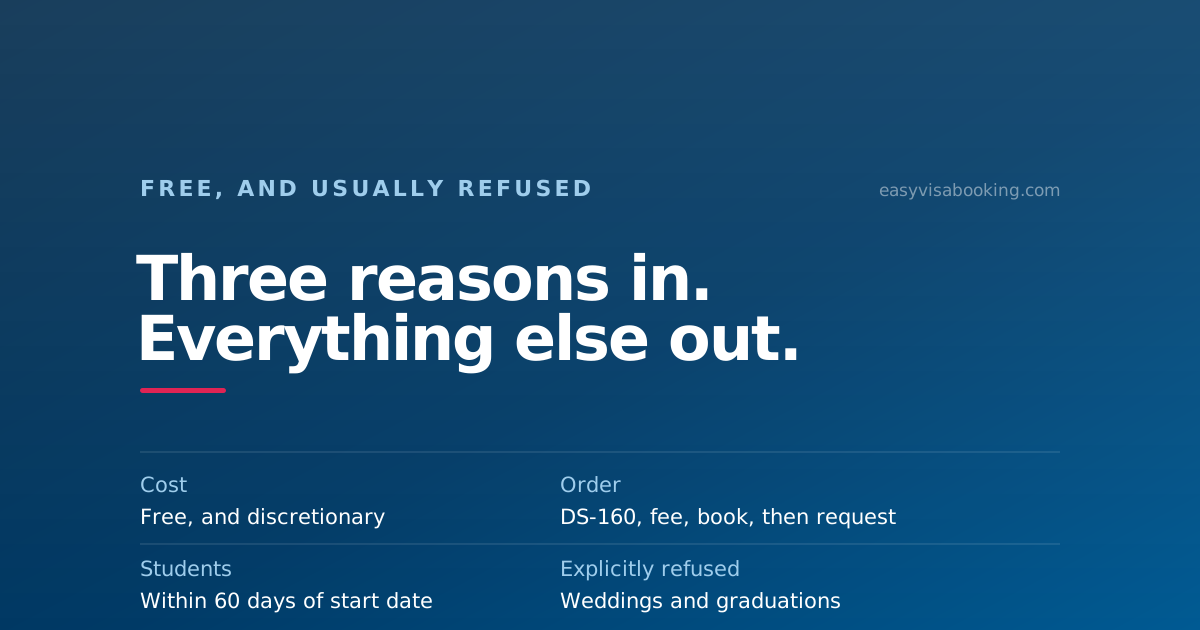
An expedited appointment request is free, discretionary, and granted for an urgent unforeseen situation: urgent medical care, the funeral of an immediate family member in the United States, or a student within 60 days of a programme start date. Weddings, graduations, assisting a pregnant relative, annual conferences and last-minute tourism are named as not qualifying. You must book a regular interview first, because the request attaches to an existing appointment.
At a glance
- Cost
- Free. It is not related to the $750 paid pilot in any way
- Who decides
- The consular section, at its discretion. There is no appeal
- Sequence
- DS-160, pay the fee, book the first available interview, then request
- Medical proof
- Two letters: your doctor, and the treating physician or hospital in the US
- Funeral definition
- Mother, father, brother, sister or child, in the United States
- Student window
- Within 60 days of the start date, with an original I-20 or DS-2019 and SEVIS fee evidence
- Keep your appointment
- Do not cancel the original booking while a request is pending
What an expedite request actually is
It is a request to a consular section to move an interview forward because of an urgent situation you could not have foreseen. It is free. It is decided by the post, at its discretion, and there is no appeal and no second opinion.
Three things follow from that, and they set expectations correctly before you spend any effort:
- It is not a queue-jumping mechanism. It exists for situations where waiting is not a reasonable thing to ask of somebody, not for situations where waiting is inconvenient or expensive.
- Refusal is the normal outcome. A great many requests are made and most are declined. That is not a sign of a bad post; it is the criteria working.
- You realistically get one credible attempt. Nothing formally limits you to one, but a post that has already refused a weak request from you is not reading the next one generously.
What qualifies, and the documents each one needs
Consular guidance describes the test as an urgent, unforeseen situation such as a funeral, a medical emergency or a school start date. Three categories carry in practice, and each has a documentary shape.
| Category | What it covers | Documents expected |
|---|---|---|
| Urgent medical care | Obtaining urgent medical care in the United States, or accompanying a relative or employer who is | A letter from your doctor describing the condition and why care is sought in the US, and a letter from the physician or hospital in the US confirming they are prepared to treat the case |
| Funeral or repatriation | Attending the funeral of, or arranging repatriation of the body of, an immediate family member in the United States. Immediate means mother, father, brother, sister or child | Evidence of the death and of the relationship, and details of the arrangements |
| Student or exchange start date | Students and exchange students within 60 days of their programme start date | Original Form I-20 or Form DS-2019 showing a start date within 60 days, and evidence that the SEVIS fee has been paid |
Criteria and documentary requirements as published in consular expedited appointment guidance. Retrieved 19 August 2026. The exact process and the evidence a post will accept vary by location, so follow your own post's instructions.
The medical row is where genuine emergencies most often fail, and it is worth stating on its own. Two letters are expected, not one. A letter from your own doctor establishes the condition. A letter from the treating hospital or physician in the United States establishes that the treatment is actually arranged there. A request with only the first reads as a plan rather than an emergency.
The funeral row is the one that causes the most distress, so it is better read here than discovered later. Grandparents, aunts, uncles, cousins and in-laws are outside the definition, however close the relationship was in life. That is the definition consular guidance uses, and it does not bend for how a family actually works.
What is explicitly refused
These are not borderline cases that a good letter might carry. They are named in consular guidance as not qualifying:
- Weddings. Including your own family's, and including ones already booked and paid for.
- Graduation ceremonies. Same reasoning: a known date, foreseeable well in advance.
- Assisting a pregnant relative. Named specifically, which tells you how often it is asked.
- Annual business, academic or professional conferences. The word doing the work is annual: a yearly event is not unforeseen.
- Last-minute tourism. Including non-refundable bookings.
The common thread is foreseeability. A wedding is set months ahead. A conference recurs every year. A visa interview queue was known when you booked the flights. None of that makes the trip unimportant, and the guidance is not saying it does. It is saying the situation is not unforeseen, which is the actual test.
A refused weak request costs you the strong one
This is the practical reason to take the list seriously rather than trying anyway. Consular sections see a very large volume of these, and an applicant who has already submitted a wedding request is not starting from neutral if something genuinely urgent happens two months later. If your reason is on the refused list, the honest move is not a better-worded version of the same request. It is to work the calendar instead and keep your credible attempt intact.
The sequence, and why the order matters
This is where a surprising number of urgent cases lose days they did not have.
- Complete the DS-160. Carefully. An error here means a new form, a new confirmation number, and a re-linking exercise you cannot afford in an emergency.
- Pay the visa application fee and wait for it to be recognised against your account. Bank payments can take a business day or two to post.
- Schedule the first available interview appointment. Whatever date it is. This is the step people skip because the date looks useless, and it is the gate: a consular section will only consider an expedite request once you hold an appointment.
- Submit the expedite request through the route your post specifies, with the documents attached rather than promised.
- Keep the original appointment. Do not cancel it while the request is pending. If the request is refused, that date is what you still have, and at a long-queue post it may be irreplaceable.
Applying in Mexico or Canada? There is a second, paid route there that is decided on where you are applying rather than on urgency, and it is worth understanding alongside this one. Read the $750 expedited appointment explained.
Writing a request that reads as credible
Assume the person reading it has a large stack of these and perhaps a minute for yours. Four things separate the ones that land.
- Lead with the category, not the story. Open by saying which of the recognised situations this is. A narrative that arrives at the point in paragraph four is a narrative that does not get to paragraph four.
- Attach the documents, do not describe them. "A letter from the hospital is attached" beats "the hospital has confirmed they will treat me". Every unevidenced assertion is a reason to decline.
- Explain the unforeseen part explicitly. The test is not that the trip is important, it is that the situation could not reasonably have been anticipated. Say what changed and when.
- Give the date you actually need and why. A specific date tied to a treatment plan, a funeral or a programme start is checkable. "As soon as possible" is not.
And keep it short. This is a document that is assessed on its attachments.
If it is refused
There is no appeal, and re-sending the same request with more feeling does not help. What is left is the ordinary machinery, which is where most earlier dates come from anyway:
- You still hold your appointment, assuming you followed step five above. That is the asset.
- Work the calendar. Cancellations return to the pool continuously, and at most posts that is the realistic supply.
- Check every post your account offers you. Intra-country gaps are large: in August 2026 Australia ran from about 15 days at Perth to about 435 at Sydney, and India from about 60 days at Kolkata to about 315 at Hyderabad.
- Widen the range of dates you will accept. The single biggest lever you control, and it costs nothing.
- If your circumstances genuinely change, and the new situation meets the criteria with documents behind it, a fresh request is not barred. Make it on the new facts, not on the old ones restated.
How it compares to everything else
Two of the five rows below cost nothing, and if you qualify for the first one you should stop reading and go and make it.
Every route to an earlier interview, with the free ones first
Costs exclude the US government fees everybody pays: the MRV application fee, and the $250 visa integrity fee where your post is collecting it. Third-party pricing changes, so verify with each provider directly.
| Option | Cost | Decided on | Best suited to |
|---|---|---|---|
| Expedite request to the consulate | Free | Documented urgency, at the post's discretion | Medical emergencies, funerals, student start dates |
| Do it yourself | Free | Whether you are looking when something opens | Flexible dates, a soft deadline |
| Slot-availability websites | Free tier; paid alert plans, billed whether or not a date appears | Whether you can act on a notification within seconds | Applicants who can drop everything |
| $750 government paid expedite | $750 per applicant, up front and non-refundable | Where you are applying, not how urgent it is. Mexico and Canada only, B-1/B-2 only | A hard deadline inside weeks, at one of those posts |
| Easy Visa Booking us | From $100, paid only on success | Persistence on the calendar, across the posts you can use | Long waits, a fixed deadline, and no time to watch a portal |
The categories above are the alternatives you are already comparing, not endorsements. We have no commercial relationship with any provider in them, and pricing models change, so verify current terms directly.
What our row gives you that the ones above it do not
- You pay only if the date actually moves. From $100, charged when an earlier interview is secured. An alert plan bills you every month whether or not anything opens. The $750 lane is paid up front and not returned. Ours is the only paid row where a result you did not get costs you nothing.
- It is what is left when the free route says no. Most people reading this page will be refused, not because their reason is not real but because it is not unforeseen. Rescheduling is the mechanism that remains, and it is the one we do.
- The watching stops being your problem. Every free and alert-based route ends the same way: you, logged in, acting within seconds, at whatever hour the opening lands. Our team carries the rescheduling work instead.
- A wide date range is the biggest lever you control. If you can accept any date inside a broad window rather than one specific morning, the odds of moving your interview go up sharply. Tell us the widest range your travel plans allow and we will tell you honestly how it looks before you commit to anything.
- Nothing is asked on trust. A named founder, real support channels, published terms and refund policy, and a written statement that nobody can promise you a date. Read all of it before you speak to us.
If you meet the medical, funeral or student criteria with documents behind you, make the free request and do not pay anybody, us included. It is decided by the only people who can actually move your date, and it costs nothing.
The reader who should not pay anybody is the student who has just realised they are inside the 60 day window. Get the original I-20 or DS-2019 and the SEVIS receipt together, book the first available appointment, and make the request today. That route is designed for exactly your situation.
Frequently asked questions
What qualifies as an emergency for a US visa appointment?
Consular sections describe it as an urgent, unforeseen situation such as a funeral, a medical emergency, or a school start date. In practice three categories carry: urgent medical care in the United States, the funeral or repatriation of an immediate family member there, and students or exchange visitors within 60 days of a programme start date. Everything else is decided case by case and most of it is refused.
What does not qualify for an expedited US visa appointment?
Consular guidance names these explicitly: travel to attend weddings or graduation ceremonies, travel to assist a pregnant relative, attending an annual business, academic or professional conference, and last-minute tourism. They are ordinary reasons to want an earlier date and they are not urgent unforeseen situations, so submitting one tends to spend the credible request you had.
What proof do I need for a medical emergency request?
Two letters, not one. A letter from your doctor describing the medical condition and explaining why care is being sought in the United States, and a letter from the physician or hospital in the United States indicating that they are prepared to treat the case. A request with only the first of those is the most common reason a genuine medical emergency is refused.
Who counts as an immediate family member for a funeral request?
Consular guidance defines it narrowly: mother, father, brother, sister or child. The death has to be in the United States, and the purpose is attending the funeral or making arrangements to repatriate the body. Grandparents, aunts, uncles, cousins and in-laws sit outside that definition however close the relationship actually is, which is a hard thing to be told and better learned before you apply than after.
Can students get an expedited appointment?
Yes, within a defined window. The option is limited to students and exchange students within 60 days of their programme start date, and it requires an original Form I-20 or Form DS-2019 showing that start date together with evidence that the SEVIS fee has been paid. Outside 60 days the route is not open, which is a strong argument for starting the process as early as your documents allow.
Do I have to book a normal appointment before requesting an expedite?
Yes, and this order catches people out constantly. You submit the DS-160, pay the application fee, and schedule the first available interview appointment. Only then will a consular section consider an expedite request. It is an upgrade to an existing booking, not a way to book from nothing, and you should keep the original appointment until a decision comes back.
Is an emergency appointment the same as the $750 paid expedite?
No, and they are easy to confuse. The emergency request is free, discretionary, available at posts worldwide and decided on documented urgency. The $750 expedited appointment is a paid pilot running only at designated missions, currently Mission Mexico and Mission Canada, for B-1 and B-2 applicants, and it is not assessed on urgency at all. If you qualify on urgency grounds, make the free request first.
The bottom line
The expedite request is the best free thing available in this whole process, and it is narrower than almost anyone expects. Three situations carry: urgent medical care with two letters behind it, the funeral of a mother, father, brother, sister or child in the United States, and a student inside 60 days of a programme start with the original documents in hand.
Everything else that people feel is urgent, and much of it genuinely is, sits outside the test because it was foreseeable. Weddings and graduations are named specifically, which should tell you how many of those requests arrive.
So the useful discipline is honest triage. If you are inside the criteria, book an appointment today and make the request with the documents attached. If you are not, do not spend the attempt. Work the calendar, widen your dates, and check every post you are entitled to use.
What nobody can promise you
Nobody outside the US government can guarantee an interview slot, a timeframe, or a visa decision. We cannot either, and we cannot influence an expedite decision in any way: it is made by the consular section on the documents you provide. What we offer is that the rescheduling work gets done properly and that you pay only if it produces a result.
Sources
- US Department of State, Visa Appointment Wait Times. That consular sections may expedite an interview date for an urgent, unforeseen situation such as a funeral, medical emergency or school start date, and that the process varies by post. Retrieved 19 August 2026.
- US Travel Docs, How to request an expedited interview. The request sequence and the documentary requirements: doctor's letter plus a letter from the treating US physician or hospital, the immediate family definition for funerals, and the 60 day student window with an original I-20 or DS-2019 and SEVIS fee evidence. Retrieved 19 August 2026.
- US Travel Docs, Apply for an Expedited Appointment. The categories named as not qualifying: weddings, graduation ceremonies, assisting pregnant relatives, annual conferences and last-minute tourism. Retrieved 19 August 2026.
- US Department of State, Nonimmigrant Visa Expedited Appointment Pilot Program. The separate paid route, its $750 fee, and the participating missions, so the two are not confused. Retrieved 19 August 2026.
Published 28 August 2026. The expedite process and the evidence a post will accept vary by location, and every decision is discretionary. Where this page summarises criteria, your own post's instructions are the authority. This article is general information and is not legal or immigration advice.
If your reason is real, make the free request first
We would rather say that plainly than sell you something you do not need. An expedite request on documented urgency costs nothing and it beats anything a paid service can offer, ours included. Where it does not apply, because your reason is genuine but not on the list, the mechanism that is left is rescheduling, and that is what we do. Tell us your post, your current date and your deadline, and we will tell you honestly which of the two you should be using.
- From $100, and you pay only if we secure you an earlier date
- The wider the date range you can accept, the more often we can move it
- No guarantee of a date, stated plainly before you decide anything
Easy Visa Booking is an independent scheduling assistance service, not affiliated with the US Department of State, any US Embassy or Consulate, CGI Federal or the AIS portal. All appointments are made through the official portal.