Short answer
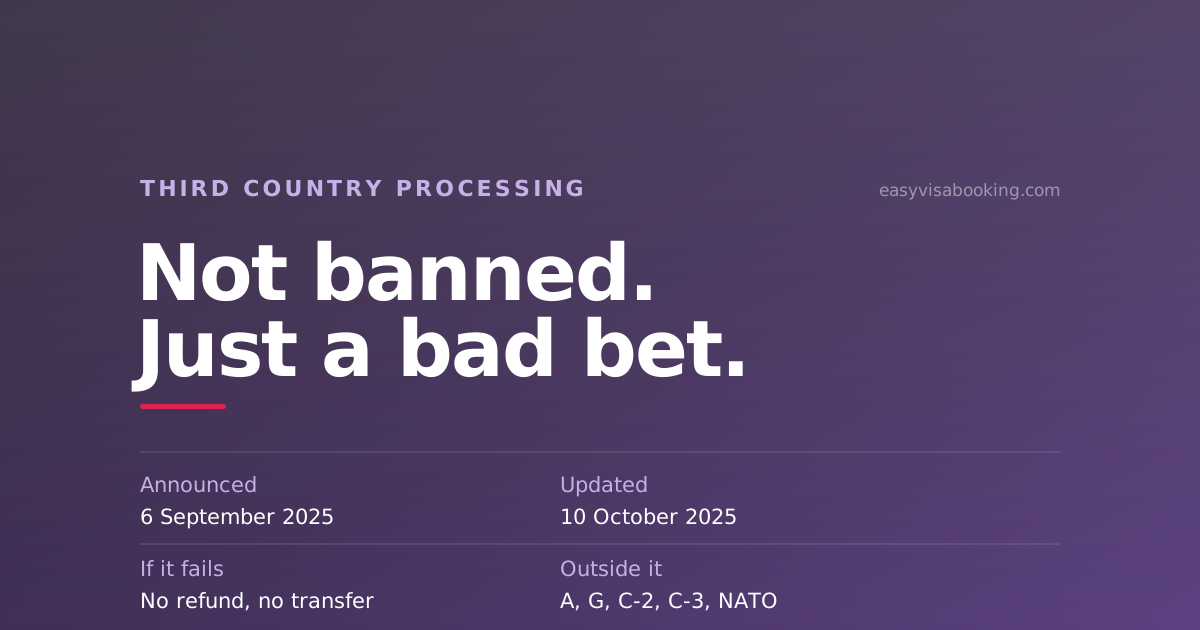
You can, but since 6 September 2025 you are directed not to, and the consequences of trying fall entirely on you. The State Department instructs nonimmigrant visa applicants to schedule at the post in their country of nationality or legal residence, and warns those who go elsewhere that they may find it harder to qualify. Fees are neither refunded nor transferred. It is guidance rather than a ban, which is exactly what makes it dangerous: nothing stops you booking, and nothing protects you when it fails.
At a glance
- Announced
- 6 September 2025, effective immediately, updated 10 October 2025
- What it says
- Schedule in your country of nationality or legal residence
- Is it a ban?
- No. It is guidance, and existing appointments were generally not cancelled
- The warning attached
- Applicants scheduling elsewhere may find it more difficult to qualify
- Money at risk
- The MRV fee, which is neither refunded nor transferred between posts
- Residence must be shown
- Applying where you live rather than where you hold nationality means proving it
- Outside the guidance
- A, G, C-2, C-3, NATO and diplomatic categories, plus limited humanitarian and medical emergency exceptions
What changed, precisely
Third country national processing, to use the term the immigration bar uses, meant applying for a US visa somewhere that was neither your home country nor your country of residence. It was ordinary practice for decades, and for applicants facing a queue measured in months it was often the only sensible move.
On 6 September 2025, effective immediately, the State Department published guidance directing nonimmigrant visa applicants to schedule at the post in their country of nationality or residence. An update followed on 10 October 2025.
Three features of how it was written decide everything downstream:
- It is guidance, not a prohibition. No outright restriction was imposed, and the systems will still let you book. That is the trap. A rule that blocks you costs you nothing; guidance that discourages you costs you the fee.
- Existing appointments were generally not cancelled. Anyone already booked at a third country post before the announcement was not swept out, which is why you still hear about people who did it successfully. They booked before.
- The warning is about qualifying, not about scheduling. The department said applicants who schedule outside their country of nationality or residence might find it more difficult to qualify for the visa. That is a warning about the interview, not the calendar, and it is the part people skip.
What "country of residence" actually means
The guidance has two limbs, nationality and residence, and the second one is where most real cases sit.
Residence means where you actually live, on a status that permits it. The State Department states that applicants applying in their country of residence rather than their country of nationality must be prepared to demonstrate that residence. Consular practice varies, but the evidence that satisfies this question is the ordinary evidence of a life somewhere:
- A residence permit, long-term visa or equivalent status document
- An employment contract or a business registration, with pay records
- A tenancy agreement or property ownership, and utility accounts in your name
- Local bank activity over a period, not a freshly opened account
- Family living with you, school enrolment, a driving licence
What does not make you resident: a tourist entry, a short business trip, a visitor visa for the country you are standing in, or an address borrowed from a relative. This distinction is the whole test, and the number of applicants who assume a few weeks in a country counts is the reason it needs stating.
Who can still legitimately apply abroad
Three groups, and if you are in one of them the news here is good rather than bad.
Expatriates applying where they live
This is the largest group by far and it is not an exception, it is the rule working as intended. An Indian national resident in the UAE applies in the UAE. A Filipino national resident in Canada applies in Canada. A British national resident in Singapore applies in Singapore. Your residence is your post, and the only new obligation is being ready to demonstrate it.
Nationals of countries without routine visa operations
Where the US is not conducting routine nonimmigrant visa operations, applicants are directed to a designated post instead, unless their residence is elsewhere. That is a specific mechanism rather than a free choice of country, so check what has been designated for your nationality rather than picking the nearest convenient post.
Categories outside the guidance
A, G, C-2, C-3 and NATO categories, and diplomatic and official visas, sit outside it. There is also limited allowance for exceptions on humanitarian or medical emergency grounds, or for foreign policy reasons. If you are reading this page because of a family medical emergency, that route exists and it is worth asking the post about directly.
Why it is a bad bet for everyone else
Lay out the actual arithmetic for someone resident in a long-queue country thinking about flying somewhere shorter.
| What you spend | What happens if it does not work |
|---|---|
| The MRV application fee | Not refunded, and not transferred to another post. You pay again at home |
| Flights and accommodation | Yours. Often the largest single line, and entirely unrecoverable |
| Time off work | Spent, whatever the outcome of the interview |
| An optional expedite fee, where one exists | Non-refundable on top, at a post you were advised not to use |
| Your place in the queue at home | Still there, unchanged, and now several months later than when you started |
Fee treatment as stated in the State Department's country of residence guidance. Retrieved 19 August 2026.
And weigh that against what you were escaping. If your post at home is six months out and the alternative post is one month out, you are spending several thousand dollars and accepting a stated qualification risk to save five months on a queue you could have kept working from home for nothing.
We turn this work away, and it costs us business
We are asked to arrange appointments in the UAE, Canada and Mexico for applicants who live in none of those places several times a month, and we say no every time. Not because there is a rule stopping us booking it, but because the likeliest ending is that you spend the fee and the airfare and are sent home to apply properly. Taking money for that would be taking money for a plan we expect to fail. If someone else offers you the same thing enthusiastically, that enthusiasm is the warning.
The four routes that closed
Each of these was a genuine strategy before September 2025 and each has an ecosystem of old advice still describing it as current.
- India to the UAE. The biggest of them by volume. Fly to Dubai or Abu Dhabi, interview there, return. The UAE is now the post for people who live in the UAE, and the mission has spent much of 2026 running reduced operations besides.
- India and elsewhere to Canada. Once a well worn route, and now doubly unattractive: the guidance applies, and Canadian visitor visa queues are among the longest in the world, with Toronto sitting near 495 days.
- Latin America to Mexico. Still popular in advice written before the guidance, and now carrying the same warning as everywhere else. That Mexico participates in the $750 expedite pilot makes it more tempting, not more available.
- South and Southeast Asia to Thailand. A long standing regional route, and subject to exactly the same direction.
If you find a guide that recommends any of these without mentioning September 2025, you have found a page that has not been updated in a year. Check the date on anything you read about this, including this page.
Resident in the UAE and wondering what your own post looks like now? Nonimmigrant appointments are being released again in Abu Dhabi and Dubai, on a schedule the mission publishes. Read US visa appointments in Abu Dhabi and Dubai are open again.
What to do instead
The exit being closed does not leave you with nothing. It leaves you with the same four levers as everyone else, and they are worth more attention now than they used to get.
- Book any date at your own post, immediately. A distant confirmed appointment is the asset everything else depends on. You cannot reschedule what you do not hold.
- Check every post in your own country. Intra-country spreads are enormous and almost nobody uses them. India ran from about 60 days at Kolkata to about 315 at Hyderabad in August 2026. Australia ran from about 15 days at Perth to about 435 at Sydney. Those are legitimate moves inside the guidance, and they are larger than most people expect.
- Widen the range of dates you will accept. The single biggest lever you control, and it costs nothing.
- Use the expedite request if you genuinely qualify. Free, discretionary, decided on documented urgency. Medical emergencies, funerals of immediate family, unavoidable urgent business travel. Not a holiday.
Notice that the second one is the closest legitimate substitute for what third country processing used to do. You are still moving to a shorter queue, you are just doing it inside your own country, where nobody has advised you not to.
How your options compare once the exit is closed
With flying abroad off the table, the honest set of routes to an earlier interview is short, and the first two cost nothing.
What is left when you have to apply where you live
Costs exclude the US government fees everybody pays: the MRV application fee, and the $250 visa integrity fee where your post is collecting it. Third-party pricing changes, so verify with each provider directly.
| Option | Cost | What it actually does | Best suited to |
|---|---|---|---|
| A quieter post in your own country | Free, plus domestic travel | Moves you to a shorter queue without leaving the guidance. Subject to consular district rules. | Anyone in a large country with more than one post |
| Do it yourself | Free | You check the portal and reschedule when something opens. | Flexible dates, a soft deadline |
| Expedite request to the consulate | Free | A discretionary decision on documented urgency, at your own post. | Medical emergencies, funerals, documented urgent travel |
| $750 government paid expedite | $750 per applicant, up front and non-refundable | An interview within 10 business days, but only if you are applying at Mission Mexico or Mission Canada in the first place. | B-1/B-2 residents of those countries with a hard deadline |
| Easy Visa Booking us | From $100, paid only on success | Our team takes on the rescheduling work at the post you are supposed to use, and keeps working it until an earlier interview date opens. The wider your acceptable date range, the more often it moves. | Long waits, a fixed deadline, and no time to watch a portal |
The categories above are the alternatives you are already comparing, not endorsements. We have no commercial relationship with any provider in them, and pricing models change, so verify current terms directly.
What our row gives you that the ones above it do not
- You pay only if the date actually moves. From $100, charged when an earlier interview is secured. Compare that with the route this article is about, where the fee, the flights and the accommodation are all spent before anybody knows whether it worked. Ours is the only paid row where a result you did not get costs you nothing.
- We will tell you when the answer is no. Including when you ask us to book you somewhere you do not live. That is business we turn away, and it is the clearest evidence we can offer that the advice is not shaped by the invoice.
- Every post you are entitled to use gets looked at. The intra-country spread is the legitimate version of what third country processing used to do, and it is the check applicants skip most often.
- A wide date range is the biggest lever you control. If you can accept any date inside a broad window rather than one specific morning, the odds of moving your interview go up sharply. Tell us the widest range your travel plans allow and we will tell you honestly how it looks before you commit to anything.
- Nothing is asked on trust. A named founder, real support channels, published terms and refund policy, and a written statement that nobody can promise you a date. Read all of it before you speak to us.
If your own country has a quieter post your district allows you to use, do that and pay nobody. It is the largest free improvement available to most readers of this page, and it is entirely within the guidance.
The reader who should not pay anybody, us included, is the expatriate who came here worried and has just learned that their country of residence is their post. Nothing has gone wrong for you. Book at home, work the calendar, and spend nothing.
Frequently asked questions
Is it illegal to apply for a US visa in another country?
No, and that distinction matters. The State Department issued guidance, not a prohibition. Applicants are directed to schedule at the post in their country of nationality or legal residence, and existing third country appointments were generally not cancelled. What changed is that the department warned applicants who schedule elsewhere that they might find it more difficult to qualify for the visa. It is still possible, it is simply a much worse bet than it was.
When did third country US visa processing change?
On 6 September 2025, effective immediately, with an update published on 10 October 2025. Before that date, applying at a post outside your home country was a well established route, and the UAE, Canada, Mexico and Thailand were all heavily used by applicants escaping long queues at home.
What counts as my country of residence?
Where you actually live, on a status that allows it, rather than where you happen to be travelling. The State Department states that applicants applying in their country of residence rather than their country of nationality must be prepared to demonstrate that residence. In practice that means a residence permit or long-term visa, and the ordinary evidence of a life there: a tenancy or property, employment, bank activity, family. A tourist entry does not make you resident anywhere.
Do I get my fee back if I apply in the wrong country?
No. The MRV fee is non-refundable and non-transferable, and the guidance states plainly that fees paid are neither refunded nor transferred between posts. That is the financial core of this: you pay the fee, book the flights and accommodation, and if the plan does not work none of it comes back. Layering an optional expedite fee on top only increases what is at risk.
Who is outside this guidance?
It does not apply to applicants for A, G, C-2, C-3 or NATO visas, or to diplomatic and official categories. There is also limited allowance for exceptions on humanitarian or medical emergency grounds, and for foreign policy reasons. Separately, nationals of countries where the US is not conducting routine nonimmigrant visa operations are directed to a designated post, unless their residence is somewhere else.
I live abroad on a work permit. Which post do I use?
The one in the country where you live. That is the whole point of the residence limb of the guidance, and for expatriates it is the reassuring half of the news: an Indian national resident in the UAE applies in the UAE, and a Filipino national resident in Canada applies in Canada. Be ready to show the residence, because you may be asked to.
Can I still fly to Canada to use the $750 paid expedite?
Not usefully. The expedite fee buys an earlier interview at a participating mission, currently Mission Mexico and Mission Canada, but it does not change where you are supposed to apply. An applicant resident elsewhere who books in Canada and pays $750 has spent the application fee and the expedite fee, neither of which is refundable, on an appointment the department has already advised against. It is the most expensive version of this mistake.
The bottom line
Third country processing was not banned. It was discouraged, in writing, with a warning attached about qualifying and an explicit statement that your fees do not follow you. For a rule you can still technically ignore, that is about as clear as governments get.
If you live somewhere, that somewhere is your post, and the guidance is not aimed at you. If you were planning to fly to a shorter queue, price the whole thing honestly: fee, flights, accommodation, time off, and a stated risk that the interview goes worse than it would have at home, against a queue that is still sitting there when you get back.
The closest legitimate substitute is the one almost nobody uses. Check every post inside your own country. The gaps are bigger than you think, and using them costs you a domestic flight rather than an international one.
What nobody can promise you
Nobody outside the US government can guarantee an interview slot, a timeframe, or a visa decision. We cannot either, and we cannot tell you how a particular consular officer will treat a particular case. What we offer is that the work gets done properly, at the post you are supposed to use, and that you pay only if it produces a result.
Sources
- US Department of State, Adjudicating Nonimmigrant Visa (NIV) Applicants in Their Country of Residence. The guidance itself: 6 September 2025, updated 10 October 2025. Applicants directed to their country of nationality or legal residence, fees neither refunded nor transferred, and the requirement to demonstrate residence. Retrieved 19 August 2026.
- Mintz, State Department Adjudicating Nonimmigrant Visa Applicants in Their Country of Nationality or Residence. That the department did not impose an outright restriction, that existing third country appointments would generally not be cancelled, and the warning that qualifying may be more difficult. Retrieved 19 August 2026.
- Morgan Lewis, US Department of State Policy Changes Significantly Impact Consular Nonimmigrant Visa Processing. The categories outside the guidance, the humanitarian and medical emergency exceptions, and the treatment of nationals of countries without routine nonimmigrant visa operations. Retrieved 19 August 2026.
- US Department of State, Nonimmigrant Visa Expedited Appointment Pilot Program. The participating post list, and why paying the expedite fee does not change where you are supposed to apply. Retrieved 19 August 2026.
- US Department of State, Visa Appointment Wait Times. The interview wait at your own post, which is the number this decision should actually be weighed against. Retrieved 19 August 2026.
Published 27 August 2026. Consular practice on residence evidence varies by post and is applied case by case. Where this page summarises guidance, the department's own page is the authority. This article is general information and is not legal or immigration advice.
If the exit is closed, the queue at home is the whole game
That is the practical result of the 2025 guidance for most applicants, and it is why rescheduling matters more now than it did two years ago. You cannot leave the queue, so the only lever left is working it. If you do not have the time or the hours to do that yourself, our team can take it on for your post. Tell us where you are applying, your current date and the widest range you could accept, and we will tell you honestly whether it is worth paying us at all.
- From $100, and you pay only if we secure you an earlier date
- The wider the date range you can accept, the more often we can move it
- No guarantee of a date, stated plainly before you decide anything
Easy Visa Booking is an independent scheduling assistance service, not affiliated with the US Department of State, any US Embassy or Consulate, CGI Federal or the AIS portal. All appointments are made through the official portal.