Short answer
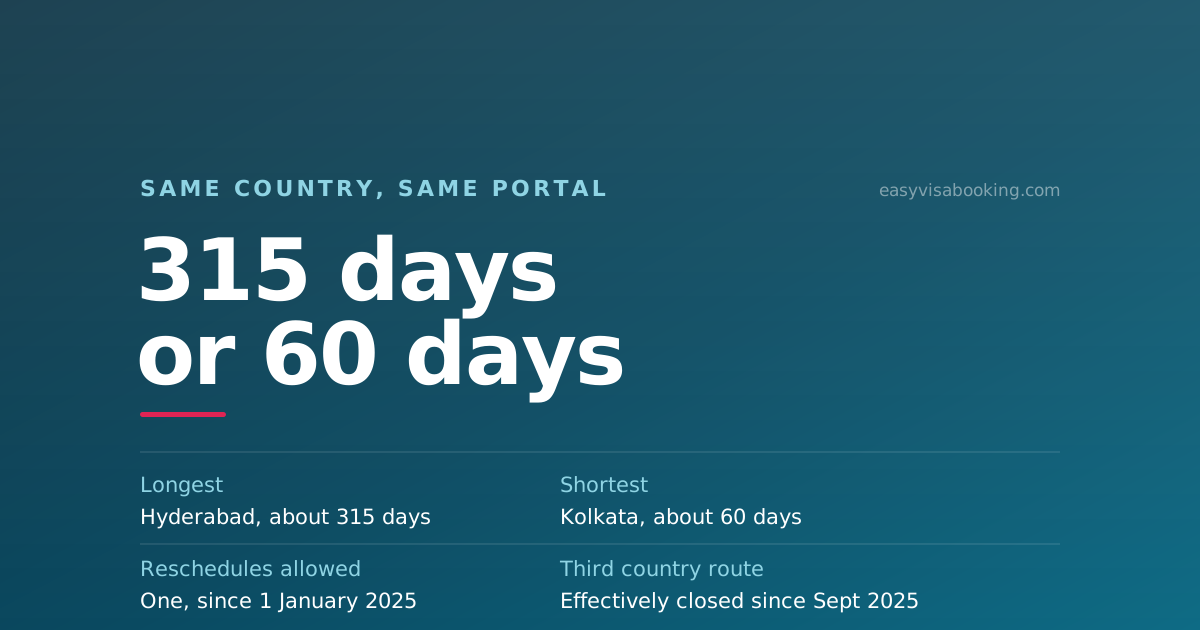
In August 2026 the interview-required US visitor visa wait in India ran from about 60 days at Kolkata to about 315 days at Hyderabad, with Mumbai and New Delhi both near 255. Same country, same portal, same rules, roughly eight months apart. India also allows only one reschedule per MRV fee, so the post you apply at and the single move you make matter more here than almost anywhere.
At a glance
- Longest visitor wait
- Hyderabad, about 315 days
- Shortest visitor wait
- Kolkata, about 60 days
- Mumbai and New Delhi
- About 255 days each
- Students and workers
- Far shorter. Around 75 days for F, M and J and 45 days for H, L, O, P and Q at Mumbai and New Delhi
- Reschedules allowed
- One per MRV fee, since 1 January 2025
- Applying abroad instead
- Directed against since September 2025, and fees are not transferred
- What the figure excludes
- Administrative processing after the interview, which is separate and unpredictable
The numbers, by post and by category
Two views, because they answer different questions. First, where the calendar actually sits, in days, across the five Indian posts.
| Post | Visitor B-1/B-2 | Student F, M, J | Petition-based H, L, O, P, Q |
|---|---|---|---|
| Hyderabad | About 315 days | About 135 days | About 150 days |
| Mumbai | About 255 days | About 75 days | About 45 days |
| New Delhi | About 255 days | About 75 days | About 45 days |
| Kolkata | About 60 days | About 45 days | About 45 days |
| Chennai | Not published in this record | Not published in this record | Not published in this record |
Interview-required waits as recorded from the State Department's wait time tool in August 2026. Retrieved 19 August 2026. The State Department's own published averages in late July 2026 put Mumbai at 11 months, Hyderabad at 10, New Delhi at 8 and Chennai at 7, which is the same picture measured differently. Check the official tool for your post before deciding anything.
Three things fall out of that table immediately.
- Kolkata is the outlier and nobody uses it. Around 60 days against 315 at Hyderabad is not a marginal difference. It is the difference between travelling this year and travelling next.
- The visitor queue is the bad queue. At Mumbai and New Delhi a student wait was roughly a third of the visitor wait and a petition-based wait roughly a sixth. If you are in one of those categories the headline number is not your problem.
- Hyderabad is worst on every line. It carries the longest visitor wait and the longest student and worker waits too, which tells you the constraint there is capacity rather than category mix.
Why one country has an eight month spread
Nothing in the rules differs between Indian posts. Same scheduling platform, same fee, same reschedule allowance, same DS-160. A wait time is just staffing divided by demand, and both vary sharply across a country of this size.
Hyderabad sits at the centre of a region that generates enormous petition-based and student volume, and every one of those interviews consumes capacity that could otherwise go to visitor cases. Mumbai and New Delhi are the two largest posts and absorb the broadest mix. Kolkata serves a smaller catchment with lighter visitor demand, and the result shows up in its calendar.
The self-reinforcing part is what makes it usable. Applicants gravitate to the post they know, which concentrates demand where it already is and leaves the quieter post quieter. Kolkata is short partly because most people never look at it.
Check the consular district before you plan around Kolkata
We are not going to pretend that "just book Kolkata" is a universal answer, because it is not. Which Indian post you may use is governed by consular district rules and by what your scheduling account actually offers you, and those do not always follow the map you would expect. Some applicants will find the option is simply not there. Check what your account offers before you build a plan on a number from a table, including this one.
One reschedule changes how you should play this
This is the part that makes India genuinely different, and most advice written for a global audience gets it wrong.
Since 1 January 2025 an Indian applicant has had one reschedule per MRV fee. Several countries allow three. Japan has allowed six. With six attempts you can take a small improvement now and keep improving. With one, every move is final until you pay another fee.
Practical consequences, in order of how much they cost people:
- Do not spend it on a small gain. Moving from a date in July to one in late June feels like progress and ends your ability to reach May. Decide in advance what improvement is worth your single attempt, and hold to it.
- Take the first date you are offered when you book. Whatever it is. Your one attempt only exists if you hold a confirmed appointment, and a distant date you can move beats no date at all.
- Watch the MRV clock. The fee is valid for a year from payment and your interview has to be scheduled inside that window. An unused attempt is worth nothing once the receipt has expired.
- Do not test the system. There is no dry run. An attempt is consumed by a completed change, and there is no undo.
Before you use your one attempt, read this. The rules on what consumes an attempt, when the change window locks, and what it costs to get another, are in can you reschedule a US visa appointment to an earlier date. It is the most important page on this site for an Indian applicant.
The Dubai and Toronto route is closed
For years the answer to an Indian queue was to leave it. Applicants flew to Dubai, Abu Dhabi, Toronto or Bangkok, interviewed there, and came home with a visa while the Indian calendar stayed full. Whole businesses were built on it.
That changed on 6 September 2025, with an update on 10 October 2025. The State Department directs nonimmigrant visa applicants to schedule at the post in their country of nationality or legal residence. It is not an outright prohibition, and existing third country appointments were generally not cancelled, but applicants who schedule elsewhere are warned they may find it more difficult to qualify for the visa, and fees already paid are neither refunded nor transferred.
Read the risk honestly. You would be paying for flights and accommodation, applying at a post where the department has told you the case is harder, with no refund if it does not work, in order to escape a queue you could have kept working from home for nothing. For an applicant resident in India, this is not a shortcut any more.
The narrow exceptions do exist: limited allowance for humanitarian or medical emergencies, and the guidance does not apply to A, G, C-2, C-3 and NATO categories. If you genuinely live abroad rather than merely travelling there, your country of residence is your post, and you should be prepared to demonstrate that residence.
What actually shortens an Indian wait
Four things, in the order they are worth your effort.
- Widen your acceptable date range. The biggest single lever, and it costs nothing. Hunting one specific week is a much harder problem than accepting anything inside a two month band, and with one reschedule attempt the wide range is what makes that attempt likely to land somewhere worth having.
- Check whether a quieter post is open to you. Kolkata at 60 days against Hyderabad at 315 is the largest single improvement available to anyone whose district rules allow it.
- Work cancellations, not bulk releases. At posts with waits this long, the realistic supply is appointments returning to the pool when other people move theirs. That rewards steady checking rather than any clever hour.
- Use the expedite request if, and only if, you qualify. It is free, it is discretionary, and it is decided on documented urgency: medical emergencies, the funeral of an immediate family member, unavoidable urgent business travel, documented student start dates. A holiday is not urgency, and a weak request tends to burn the one credible attempt you had.
Notice what is not on that list. There is no paid government fast lane in India: the State Department's $750 expedited appointment pilot runs at Mission Mexico and Mission Canada, and no Indian post participates.
How your options compare in India
Four routes, and the first two are free. The paid government lane that exists in North America simply is not on the table here.
Routes to an earlier interview at an Indian post
Costs exclude the US government fees everybody pays: the MRV application fee, and the $250 visa integrity fee where your post is collecting it. Third-party pricing changes, so verify with each provider directly.
| Option | Cost | What it actually does | Best suited to |
|---|---|---|---|
| Do it yourself | Free | You check the portal and spend your single reschedule when something worth having opens. | Flexible dates, a soft deadline, time to watch |
| Expedite request to the consulate | Free | A discretionary decision on documented urgency. Refused routinely, and you get one credible attempt. | Medical emergencies, funerals, documented urgent travel |
| Slot-availability websites | Free tier; paid alert plans, billed whether or not a date appears | Surfaces availability and alerts you. You still book it yourself, and you still only have one attempt. | Applicants who can act within seconds |
| All-in-one visa platforms | Service fee charged at checkout, before anything changes | Guided DS-160, document checks and appointment support in one platform. | First-time applicants wanting everything handled |
| Easy Visa Booking us | From $100, paid only on success | Our team takes on the rescheduling work for your Indian post and keeps working it until an earlier interview date opens. The wider your acceptable date range, the more often it moves. | Long waits, a fixed deadline, and no time to watch a portal |
The categories above are the alternatives you are already comparing, not endorsements. We have no commercial relationship with any provider in them, and pricing models change, so verify current terms directly. The $750 government expedite does not operate at any post in India.
What our row gives you that the ones above it do not
- You pay only if the date actually moves. From $100, charged when an earlier interview is secured. An alert plan bills you every month whether or not anything opens. A platform fee is taken at checkout. Ours is the only paid row where a result you did not get costs you nothing.
- Your one attempt gets spent deliberately. India's single reschedule is the tightest constraint in this article, and judging which opening is worth it is exactly the decision that goes wrong when you are tired and it is late.
- The watching stops being your problem. At 255 or 315 days, the free route means weeks of checking. Our team carries the rescheduling work instead.
- A wide date range is the biggest lever you control. If you can accept any date inside a broad window rather than one specific morning, the odds of moving your interview go up sharply. Tell us the widest range your travel plans allow and we will tell you honestly how it looks before you commit to anything.
- Nothing is asked on trust. A named founder, real support channels, published terms and refund policy, and a written statement that nobody can promise you a date. Read all of it before you speak to us.
If your consular district gives you Kolkata and your dates are flexible, do it yourself. A 60 day queue does not need anybody's help, and paying for one would be a waste of your money.
The reader who should not pay anybody, us included, is the student or petition-based applicant looking at the visitor visa headline and panicking. Your queue at Mumbai or New Delhi was closer to 45 to 75 days than to 255. Check your own category before you spend anything.
Frequently asked questions
How long is the US visa appointment wait in India right now?
It depends entirely on the consulate. In August 2026 the interview-required B-1/B-2 wait was about 315 days at Hyderabad, about 255 days at Mumbai and New Delhi, and about 60 days at Kolkata. The State Department's own published averages in late July 2026 put Mumbai at 11 months, Hyderabad at 10, New Delhi at 8 and Chennai at 7. Figures move week to week, so check the official wait time tool for your post rather than quoting any article.
Which Indian consulate has the shortest US visa wait?
Kolkata has consistently been the shortest of the Indian posts, and in August 2026 it was around 60 days for interview-required visitor visas against roughly 315 at Hyderabad. It is also the post applicants think about least, which is part of why it stays shorter. Whether you can use it depends on the consular district rules that apply to your application, so check before you plan around it.
How many times can I reschedule a US visa appointment in India?
Once per MRV fee, and that has been the position since 1 January 2025. It is one of the tightest allowances in the world: several countries allow three and some allow six. The practical effect is that an Indian applicant cannot iterate towards a better date. You get one move, so it has to be the right one, and using it on a small improvement is how people end up stuck.
Can I apply for a US visa in Dubai or Canada instead of India?
Not usefully any more. Since the State Department's guidance of 6 September 2025, updated on 10 October 2025, applicants are directed to schedule in their country of nationality or legal residence, and those who apply elsewhere are told they may find it more difficult to qualify. Fees are neither refunded nor transferred if it goes wrong. The UAE and Canada were the two most popular third country routes for Indian applicants, which is exactly why the guidance closed them.
Why is the wait so different between Indian consulates?
Because a wait time is staffing divided by demand, and both vary. Hyderabad serves a region with unusually heavy petition-based and student traffic, which competes for the same interview capacity as visitor cases. Kolkata's catchment is smaller and its visitor demand lighter. Nothing about the rules or the portal differs between them, which is what makes the gap usable if your consular district allows it.
Are student visa waits in India shorter than visitor visa waits?
Substantially, and deliberately so. In August 2026 the F, M and J wait was around 75 days at Mumbai and New Delhi against 255 days for visitor visas, and petition-based H, L, O, P and Q cases were shorter still at around 45 days. Consular sections prioritise students and workers against fixed start dates. If you are in one of those categories, the visitor visa headline numbers are not your queue.
Do these wait times include administrative processing?
No, and this catches people out badly. The published figure measures how far away the next interview appointment is, and nothing else. If your case goes into administrative processing after the interview, that time is additional, unpredictable and outside anyone's control. Plan the interview date with these numbers and leave real margin after it before any non-refundable travel.
The bottom line
India does not have one wait time, it has five, and in August 2026 they were about eight months apart end to end. Before you accept the number for the post you assumed you would use, find out which posts your application can actually reach.
Then treat the single reschedule as what it is: one decision, not a process. Widen the range of dates you will accept as far as your plans genuinely allow, because that is what turns one attempt into a useful one. And take the first date the system offers when you book, because everything else on this page depends on holding an appointment.
What is no longer available is the exit. Flying to Dubai or Toronto to escape an Indian queue was the standard answer for a decade and it stopped being sensible in September 2025. The queue is the queue now, and it is worked from where you live.
What nobody can promise you
Nobody outside the US government can guarantee an interview slot, a timeframe, or a visa decision. We cannot either, and at a post with a queue near 315 days we will tell you plainly when we think the odds do not justify involving us. What we offer is that the work gets done properly and that you pay only if it produces a result.
Sources
- Afno Visa Guide, US visa appointment wait times: India. August 2026 record of the State Department wait time tool by post and category: Hyderabad 315 days, Mumbai and New Delhi 255 days, Kolkata 60 days for interview-required B-1/B-2. A secondary record of an official figure, so check the official tool as well. Retrieved 19 August 2026.
- BAL Immigration News, Global visa wait times as of July 21. State Department published averages: Mumbai 11 months, Hyderabad 10 months, New Delhi 8 months, Chennai 7 months. Also the note that B-1/B-2 averages are published only where the next appointment is more than three months away. Retrieved 19 August 2026.
- US Department of State, Visa Appointment Wait Times. The official interview wait by post, which is the figure to check before making any decision based on this page. Retrieved 19 August 2026.
- RedBus2US, How many times can I reschedule my US Visa Appointment?. India's single reschedule per MRV fee since 1 January 2025, set against the allowances in other countries. Retrieved 19 August 2026.
- US Department of State, Adjudicating Nonimmigrant Visa (NIV) Applicants in Their Country of Residence. 6 September 2025, updated 10 October 2025. Applicants directed to their country of nationality or legal residence, with fees neither refunded nor transferred. Retrieved 19 August 2026.
Published 26 August 2026. Wait times move week to week and consular district rules decide which post you may use. Treat every figure here as a snapshot and the official tool as the authority. This article is general information and is not legal or immigration advice.
One reschedule attempt is a decision, not a habit
That is what makes India different from almost everywhere else. If your country allowed six attempts you could experiment, and you cannot. Spending your single move on a two week improvement, and then finding a four month one two days later, is the most common and most expensive mistake Indian applicants make. If you would rather that judgement was somebody's job, tell us your post, your current date and the widest range you could accept, and we will tell you honestly whether it is worth paying us at all.
- From $100, and you pay only if we secure you an earlier date
- The wider the date range you can accept, the more often we can move it
- No guarantee of a date, stated plainly before you decide anything
Easy Visa Booking is an independent scheduling assistance service, not affiliated with the US Department of State, any US Embassy or Consulate, CGI Federal or the AIS portal. All appointments are made through the official portal.