Short answer
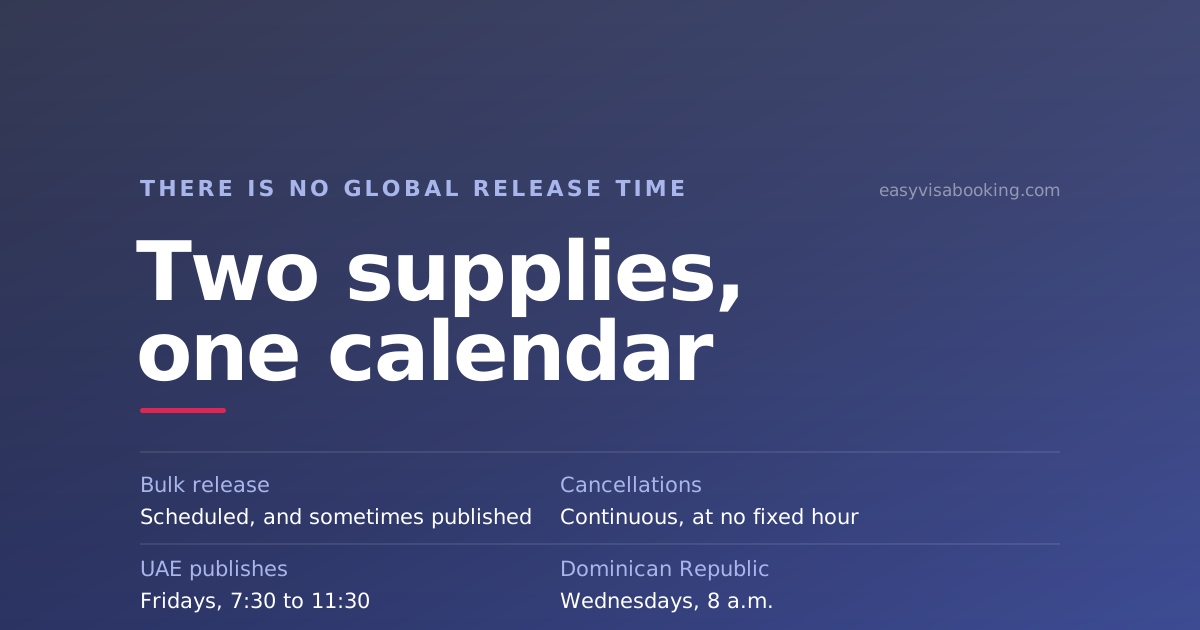
There is no worldwide release time. Each mission sets its own, a few publish it in writing, and most do not. Mission UAE releases nonimmigrant interview appointments every Friday morning between 7:30 and 11:30. The US Embassy in the Dominican Republic opens new B-1/B-2 appointments every Wednesday at 8 a.m. Where no schedule is published, the supply you are realistically competing for is cancellations, which return at no fixed hour.
At a glance
- Two different supplies
- Scheduled bulk releases, and cancellations returning continuously
- Missions that publish a window
- UAE: Fridays 7:30 to 11:30. Dominican Republic: Wednesdays at 8 a.m.
- Holidays
- Published windows skip US and local holidays, so the next one can be bigger
- Time zone
- Everything is in the consulate's local time, not yours
- The midnight theory
- A myth. Real published windows are working hours at the post
- Refreshing too hard
- Triggers temporary restrictions, commonly 24 to 72 hours
The two supplies, and why it matters which one you are chasing
Almost every argument online about "when slots open" is two people describing different things. Appointments reach the calendar by two routes, and they behave nothing alike.
| Bulk release | Cancellations | |
|---|---|---|
| What it is | The post loads a new block of interview dates onto the calendar | Somebody else moves or drops an appointment and it returns to the pool |
| Timing | Scheduled. Sometimes weekly, sometimes monthly, occasionally published | Continuous, all day, no pattern worth modelling |
| Volume | Many dates at once, gone within minutes at a busy post | One at a time, all day long |
| Who wins it | Whoever is already signed in when the window opens | Whoever happens to look in the right minute |
| Realistic for you? | Only if you know the window and can be there | Yes, and this is where most earlier dates actually come from |
Behaviour is described from what missions publish and from how the scheduling platforms present availability. Individual posts vary, and none of it is guaranteed.
The practical consequence: if your post has a queue measured in hundreds of days, chasing bulk releases is chasing an event that may happen once a month and be over in minutes. Cancellations are the supply you can actually reach, and they reward steady, unglamorous checking rather than any clever hour of the day.
Missions that publish their release window
This is the part almost nothing online tells you, and it is easy to verify: some missions state their release schedule on their own website. Two current examples, both from the posts themselves rather than from a forum.
| Mission | Published release window | Exceptions stated |
|---|---|---|
| UAE: Abu Dhabi and Dubai | Every Friday morning, 7:30 a.m. to 11:30 a.m. | US and UAE holidays. Additional appointments may be released outside the schedule |
| Dominican Republic | Every Wednesday at 8 a.m., B-1/B-2, subject to availability | US and Dominican holidays |
As published by each mission and retrieved 19 August 2026. Missions change these without announcement, so treat the mission's own page as the authority and this table as a pointer to it.
Two things follow from those examples, and they are worth more than any timing theory.
- Release is scheduled, not random. Where a post has told us, it is a fixed weekday inside working hours. That is a strong reason to disbelieve any advice built on unpredictability or on the middle of the night.
- It is a working-hours, working-day event. Both published windows sit in the local morning and both skip holidays. Whatever your post does, it is far more likely to look like that than like 2 a.m. on a Sunday.
So the first thing to do is not to look for a universal answer. It is to read your own mission's visa pages and its scheduling site's announcements section. Most say nothing. The minority that say something have handed you the most valuable fact available.
A published window is public, which cuts both ways
If your mission publishes its release schedule, every applicant reading the same page knows it too. That makes the published window the most contested period of the week at that post, and it is why we will not tell you that knowing the timing is the whole trick. It removes the guesswork. It does not remove the queue, and at a post running reduced operations a scheduled window can pass with almost nothing in it.
What to do when your post publishes nothing
Which is most of them. In that case you are working the cancellation supply, and the honest advice is simple even though it is not satisfying.
The State Department itself sets the expectation on its wait times pages: posts regularly release additional appointment slots, and applicants who want an earlier date after scheduling should check back frequently and move to another slot if one is available. That is the official method. It is also, notably, an admission that the first date you are given is not the best one available to you over time.
What that looks like in practice:
- Hold a confirmed appointment first. Nothing here works without one. Rescheduling moves a booking; it does not create one.
- Know your attempt budget. If your country allows one change per MRV fee, you are not looking for any earlier date, you are looking for a good one. If it allows six, you can afford to take an improvement and improve again.
- Decide your acceptable range before you look. The single biggest factor in whether this works is how wide a window you will accept. Hunting one specific morning is a different and much harder problem than accepting anything inside a two month band.
- Check on a rhythm, not continuously. See the routine below.
The midnight myth, and three others
"Slots drop at midnight"
The most durable belief in this subject, and the least supported. It survives because scheduling systems do housekeeping around date boundaries, so screens refresh, counters reset and availability appears to change without a single new interview being loaded. Where release schedules are actually published they are mid-morning on a working day. Staying up for midnight costs you sleep and buys nothing.
"Fridays are always best"
True in the UAE, because the mission published it. Not a rule you can carry to another country. The lesson from the UAE is not that Friday is special, it is that the post decides and sometimes tells you.
"Clearing cookies or switching browsers reveals hidden slots"
There are no hidden slots. The calendar shows what is loaded and available to your case. What repeated aggressive reloading does reliably produce is a temporary restriction on your account.
"Some accounts get better availability"
Availability differs by visa category, by post and by whether your fee and DS-160 are in order. It does not differ by account seniority or by anything you can influence. If a friend at the same post sees dates you cannot, check the category and the post before concluding anything about your account.
Patterns that do hold
Four things are worth acting on, and none of them is a secret hour.
- Working days at the post, not yours. Movement happens when consular staff are working. If the post's weekend is Friday and Saturday, its quiet days are not the same as yours.
- The days after a closure. Holidays compress work and produce cancellations from people whose plans changed. A published window that skips a holiday often means a larger release next time.
- Local mornings. Both published windows are morning windows, and cancellations cluster in working hours because that is when applicants are acting on their own bookings.
- Both posts in your country, not just the near one. Consular sections in the same country hold separate calendars and can differ by months. In Australia the spread between Sydney and Perth has run to well over a year. Applicants who only ever check the convenient post are the ones who wait longest.
Not sure how many attempts you can afford to spend? The allowance is set per country and it decides whether you take the first improvement or wait for a better one. Read how many reschedules your country actually gives you before your next attempt.
A checking routine that will not get you restricted
The tension in this whole subject is that checking more often finds more openings, and checking too often gets you locked out for a day or three. A workable middle:
- Three or four deliberate checks a day, spread out. One in the post's morning, one around midday, one in its late afternoon. Sign in, look, sign out.
- If your post publishes a window, be signed in before it opens. Signing in is the slow part and it is the part you can do in advance.
- Never sit on a reload loop. Continuous refreshing is what triggers the temporary restriction, and the restriction costs you far more checking time than you gained.
- If pages stop loading, stop for a day. That is the restriction, not an outage. It clears. Changing browser, device or network to keep going is repeating the behaviour that caused it.
- Keep your deadline in view. Beyond a point, this stops being a search and becomes a habit that eats your week. If you are three weeks in and nothing has moved, the answer is probably not more checking.
When checking is not the answer
Everything above is free and it is genuinely the method the State Department itself points applicants at. It also has one requirement that some readers simply cannot meet, which is being available. Here is the whole set, including the free rows.
Who does the watching, and what it costs
Costs exclude the US government fees everybody pays: the MRV application fee, and the $250 visa integrity fee where your post is collecting it. Third-party pricing changes, so verify with each provider directly.
| Option | Cost | What it actually does | Best suited to |
|---|---|---|---|
| Do it yourself on a routine | Free | You check on a rhythm and move when something opens. | Anyone with flexible time and a soft deadline |
| Expedite request to the consulate | Free | A discretionary decision on documented urgency, not a timing question at all. | Medical emergencies, funerals, documented urgent travel |
| Slot-availability websites | Free tier; paid alert plans, billed whether or not a date appears | Surfaces availability and alerts you. You still book it yourself, within seconds. | Applicants who can drop everything on a notification |
| $750 government paid expedite | $750 per applicant, up front and non-refundable | An interview within 10 business days, at participating missions only, currently Mexico and Canada, B-1/B-2 only. | A hard deadline inside weeks, at one of those posts |
| Easy Visa Booking us | From $100, paid only on success | Our team takes on the rescheduling work for your consulate and keeps working it until an earlier interview date opens. The wider your acceptable date range, the more often it moves. | Long waits, a fixed deadline, and no time to watch a portal |
The categories above are the alternatives you are already comparing, not endorsements. We have no commercial relationship with any provider in them, and pricing models change, so verify current terms directly.
What our row gives you that the ones above it do not
- You pay only if the date actually moves. From $100, charged when an earlier interview is secured. An alert plan bills you every month whether or not anything opens, which on a page about timing is worth noticing: you are paying for information about a queue, not for a result. Ours is the only paid row where a result you did not get costs you nothing.
- The routine stops being your problem. Everything in the section above is a habit you have to keep up for weeks, at hours set by a consulate in someone else's time zone. Our team carries the rescheduling work instead.
- Both posts in your country get looked at. The Sydney and Perth gap is the clearest example of why that matters, and it is the check applicants skip most often.
- A wide date range is the biggest lever you control. If you can accept any date inside a broad window rather than one specific morning, the odds of moving your interview go up sharply. Tell us the widest range your travel plans allow and we will tell you honestly how it looks before you commit to anything.
- Nothing is asked on trust. A named founder, real support channels, published terms and refund policy, and a written statement that nobody can promise you a date. Read all of it before you speak to us.
If your post publishes its window, your mornings are your own and your travel is flexible, do it yourself. That row is free, this article has told you how to work it, and you should keep your money.
The reader who should not pay anybody, us included, is the one whose post publishes a release window that falls inside their own working week. You have been handed the single most useful fact in this subject for nothing. Use it.
Frequently asked questions
What time do US visa appointment slots open?
There is no single time, and any article that gives you one is describing one country at best. Release is configured post by post. A few missions publish their window: Mission UAE states that nonimmigrant interview appointments are released every Friday morning between 7:30 a.m. and 11:30 a.m., and the US Embassy in the Dominican Republic states that new B-1/B-2 appointments open every Wednesday at 8 a.m. Most posts publish nothing at all.
Is there a secret time when slots appear, like midnight?
No. The midnight theory is the most persistent myth in this subject and it survives because portals do housekeeping around date boundaries, which makes screens change without any new appointments existing. Where a real schedule is known it is a working-hours schedule at the post, not the middle of the night. Losing sleep over it costs you and buys nothing.
Where do slots actually come from if my post does not publish a schedule?
From two different supplies. Bulk releases are when the post loads a new block of dates, which is scheduled but usually unannounced. Cancellations are individual appointments returning to the pool when somebody else moves or drops theirs, and those appear continuously at no fixed hour. At a post with a long queue, cancellations are the supply you are realistically competing for.
How often should I check for an earlier US visa appointment?
Often enough to catch a cancellation, rarely enough to avoid being restricted. A few deliberate checks a day, spread out, is a sustainable rhythm. The State Department's own wait times guidance tells applicants to check back frequently and move to an earlier slot if one appears, so the method is officially endorsed. Continuous automated-speed refreshing is not, and it will get your account temporarily limited.
Can refreshing too much get me blocked?
It can get you temporarily restricted, typically for something in the region of 24 to 72 hours. It usually shows up as pages that stop loading, sessions that end immediately, or a calendar returning nothing where it previously returned something. It clears on its own. Switching browser, device or network to keep going repeats the behaviour that caused it, so the fix is to stop for a day.
Does the portal show slot times in my time zone or the consulate's?
Appointment times are the consulate's local times, because that is when you have to be standing at the door. If you are checking from another country, or your post is in a different time zone from your city, work in the post's local time for everything, including any published release window. This trips up applicants in large countries more than anyone else.
Are more slots released after holidays?
Often, yes, and it is one of the few patterns that holds across posts. Consular sections do not process interviews on US or local holidays, so a closure compresses work and the days after it tend to see movement, including cancellations from people whose plans changed over the break. Published release windows also skip holidays, which means the following release can be larger than usual.
The bottom line
There is no universal release time, and the confident articles that give you one are describing a single country or repeating a forum post. What is real is that release is configured mission by mission, that a minority of missions publish their schedule, and that at everywhere else the supply you can actually reach is cancellations.
So the useful sequence is short. Read your own mission's pages first, because if it publishes a window nothing else on this page matters as much. If it does not, work the cancellation supply on a sustainable rhythm, widen your acceptable date range as far as your plans allow, and check both posts in your country rather than the convenient one.
And stop refreshing at midnight. Nobody is loading appointments then.
What nobody can promise you
Nobody outside the US government can guarantee an interview slot, a timeframe, or a visa decision. We cannot either, and no timing knowledge changes how many appointments a consulate chooses to release. What we offer is that the work gets done properly and that you pay only if it produces a result.
Sources
- US Embassy and Consulate in the United Arab Emirates, Visas. Nonimmigrant visa interview appointments released every Friday morning between 7:30 a.m. and 11:30 a.m., US and UAE holidays excepted, with occasional additional releases outside that schedule. Retrieved 19 August 2026.
- US Embassy in the Dominican Republic, Expedited Nonimmigrant Visa Appointments. New B-1/B-2 appointments opened every Wednesday at 8 a.m. subject to availability, except on US and Dominican holidays, and the instruction that applicants may reschedule themselves to an earlier date. Retrieved 19 August 2026.
- US Department of State, Global Visa Wait Times. That posts regularly release additional appointment slots, and the department's own advice to check back frequently and move to an earlier slot if one is available. Retrieved 19 August 2026.
- RedBus2US, How many times can I reschedule my US Visa Appointment?. Country-by-country reschedule allowances, which decide how many of these openings you can actually act on. Retrieved 19 August 2026.
Published 24 August 2026. Release schedules are set by each mission and change without announcement. Where a post publishes its own window, that page is the authority and this one is a summary of it. This article is general information and is not legal or immigration advice.
Knowing when they open only helps if you can be there
That is the honest limit of everything on this page. A published Friday window is useful to somebody whose Friday morning is free, and useless to somebody in a different time zone with a job. If the second one is you, our team can carry the rescheduling work for your consulate instead. Tell us your post, your current date and the widest range of dates you could accept, and we will tell you plainly how it looks before you commit to anything.
- From $100, and you pay only if we secure you an earlier date
- The wider the date range you can accept, the more often we can move it
- No guarantee of a date, stated plainly before you decide anything
Easy Visa Booking is an independent scheduling assistance service, not affiliated with the US Department of State, any US Embassy or Consulate, CGI Federal or the AIS portal. All appointments are made through the official portal.