Short answer
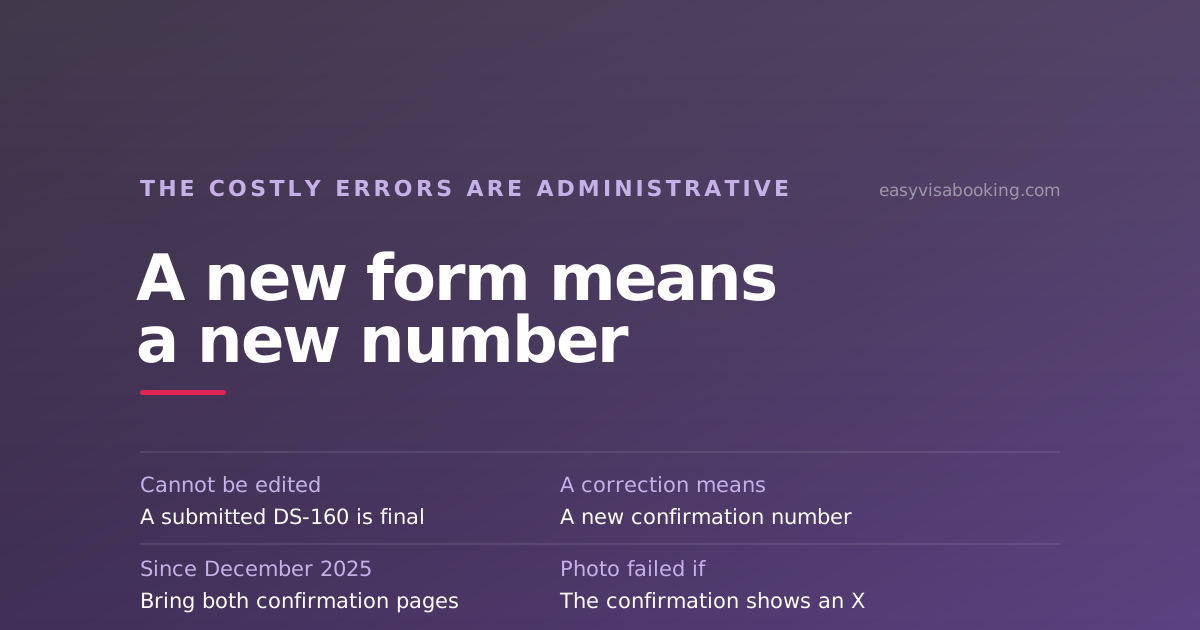
The DS-160 error that costs you most is not the one that risks a refusal. It is the one that forces a new form, because a new form means a new confirmation number and your appointment is tied to the old one. A submitted DS-160 cannot be edited. Since December 2025 applicants who submit a second form are advised to bring both confirmation pages to the interview, and where that does not resolve it, the appointment has to be rebooked under the new number.
At a glance
- Editable after submission?
- No. A correction means a completely new form
- What a new form generates
- A new application confirmation number, which your booking does not know about
- Since December 2025
- Bring both confirmation pages where a second DS-160 was submitted
- Photo upload failed if
- The confirmation page shows an X where the photograph should be
- The barcode
- Printed, and matching the number linked to your appointment. Posts refuse entry without it
- Biggest time cost
- Rebooking at a post where the queue is measured in months
The expensive mistake, and why it is expensive
Almost every DS-160 guide is written around the fear of refusal. That fear is mostly misplaced. Consular officers see typographical errors constantly and they are not what decides a case.
The problem that actually costs applicants weeks and sometimes months is structural:
- A submitted DS-160 cannot be edited.
- Correcting anything means completing a new form.
- A new form generates a new application confirmation number.
- Your appointment is linked to the old number.
Guidance since December 2025 is that applicants who submit a second DS-160 to correct errors should bring both confirmation pages to the interview. Where that does not resolve it, the appointment has to be rescheduled under the new application number, and that is where the real cost lands: a reschedule spends one of a small number of attempts, and at a post with a queue measured in hundreds of days the replacement date can be far worse than the one you had.
So the correct mental model is not "a mistake might get me refused". It is "a mistake might cost me my interview date", and that reframes how much care the form deserves.
The errors that actually cause trouble
| Error | How it shows up | What it costs |
|---|---|---|
| Photo upload failed | An X on the confirmation page where the photograph should be | Usually resolved at the interview if you bring a compliant printed photo. Ignore it and you risk a wasted appointment |
| Passport number typo | Nothing, until the details are checked against the document | Material. Worth correcting properly rather than explaining |
| Date of birth typo | Nothing, until it is checked | Material, and it can affect how records match. Correct it |
| Wrong or outdated SEVIS ID | Nothing on the form, but the record will not tie up | A frequent source of student delay, particularly where an ID from a previous school was reused |
| Confirmation page not printed | Discovered at the consulate door | Potentially the whole appointment. The barcode is your admission |
| Barcode does not match the booking | Discovered at check-in | The problem this page is about. Bring both confirmation pages if a second form was submitted |
Compiled from published DS-160 guidance and reported applicant experience. Retrieved 19 August 2026. Posts vary in how they handle each of these, so follow your own post's instructions.
Two of those deserve a sentence more. The photo requirements are strict on recency, size, sharpness and background, and the system rejects non-compliant uploads rather than accepting them quietly. The X on the confirmation page is the signal, and it is easy to miss because most people look at the barcode and stop. The printed confirmation page is not a formality: posts routinely refuse entry without the physical printout, and an email you plan to open on your phone at the door is not the same thing.
You found an error after booking. Now what?
Work through this in order rather than immediately starting a new form, because the new form is the step with the cost attached.
- Decide whether it is material. A wrong passport number, date of birth or SEVIS ID is material. A middle name spelled slightly differently from your passport, or an old address entered imprecisely, usually is not, and is raised and resolved at the interview.
- Check your post's own instructions. Handling differs, and some posts publish exactly what they want you to do about a corrected DS-160. That page beats this one.
- If you must submit a new form, do it as early as possible. Every day you wait is a day closer to the appointment, and any rescheduling is easier while you still have attempts and time.
- Update the confirmation number in your scheduling profile where the system allows it, and check whether your appointment survived the change.
- Bring both confirmation pages. The old one and the new one. That is the current guidance and it costs you two sheets of paper.
- Do not cancel your appointment to tidy things up. Cancelling does not restore attempts and does not solve the mismatch. It just removes the one confirmed date you hold.
The correction can be worse than the error
This is the judgement nobody helps applicants with, so here it is plainly. If your error is immaterial and your post has a queue measured in hundreds of days, starting a new DS-160 in pursuit of a perfect form can cost you the appointment you already have. Officers are used to small discrepancies and to applicants explaining them. They are not able to give you back a date you released. Fix what is material, raise what is not, and do not let tidiness cost you six months.
Consistency, which is a different problem
Everything above is administrative. There is a second category that genuinely does affect the interview, and it is not about typing accuracy at all.
- Your form should match your documents. Employment dates, salary, addresses and travel history should be the same on the DS-160 as on whatever you bring with you.
- It should match your previous applications. If you have applied before, that record exists. Differences that look like corrections are fine. Differences that look like edits are not.
- Purpose of travel should be one clear thing. A form describing a business trip and documents describing a family visit is not a typo, it is an inconsistency, and it is exactly what an interview is for.
- Answer the difficult questions accurately. Prior refusals, prior overstays and previous applications should be declared. An omission that is discovered is a much larger problem than the underlying fact usually is.
None of this affects your appointment date. It affects the twenty minutes at the end of the process, which is the part the appointment exists for.
About to book, and want the appointment part right? The sequence matters more than most people realise, and taking a distant date is not the mistake it feels like. Read can you reschedule a US visa appointment to an earlier date.
A ten minute check before you submit
Do this once, properly, and most of this article stops applying to you.
- Passport number, character by character, against the document itself rather than a photo of it.
- Full name exactly as it appears on the passport, including how the passport handles surnames and given names.
- Date of birth, in the format the form is using rather than the one you are used to.
- SEVIS ID from your current I-20 or DS-2019, not from a previous one.
- Photograph uploaded successfully, confirmed by looking at the confirmation page afterwards.
- Travel and employment history consistent with anything you will bring or have submitted before.
- Previous US applications, refusals and overstays declared accurately.
- Confirmation page printed, with the barcode legible.
- The confirmation number recorded somewhere you will find it when you book.
If a correction has cost you your date
The honest set of options at that point is the same as for anybody else who needs an earlier interview, and the first two are free.
Getting back to a workable date
Costs exclude the US government fees everybody pays: the MRV application fee, and the $250 visa integrity fee where your post is collecting it. Third-party pricing changes, so verify with each provider directly.
| Option | Cost | What it actually does | Best suited to |
|---|---|---|---|
| Do it yourself | Free | You check the portal and reschedule when something opens. | Flexible dates, a soft deadline |
| Expedite request to the consulate | Free | A discretionary decision on documented urgency. A form error is not urgency. | Medical emergencies, funerals, student start dates |
| Slot-availability websites | Free tier; paid alert plans, billed whether or not a date appears | Surfaces availability and alerts you. You still book it yourself. | Applicants who can act within seconds |
| $750 government paid expedite | $750 per applicant, up front and non-refundable | An interview within 10 business days, at Mission Mexico or Mission Canada only, B-1/B-2 only. | A hard deadline inside weeks, at one of those posts |
| Easy Visa Booking us | From $100, paid only on success | Our team takes on the rescheduling work for your consulate and keeps working it until an earlier interview date opens. The wider your acceptable date range, the more often it moves. | Long waits, a fixed deadline, and no time to watch a portal |
The categories above are the alternatives you are already comparing, not endorsements. We have no commercial relationship with any provider in them, and pricing models change, so verify current terms directly.
What our row gives you that the ones above it do not
- You pay only if the date actually moves. From $100, charged when an earlier interview is secured. Ours is the only paid row where a result you did not get costs you nothing.
- The watching stops being your problem. Every free and alert-based route ends the same way: you, logged in, acting within seconds, at whatever hour the opening lands. Our team carries the rescheduling work instead.
- A wide date range is the biggest lever you control. If you can accept any date inside a broad window rather than one specific morning, the odds of moving your interview go up sharply. Tell us the widest range your travel plans allow and we will tell you honestly how it looks before you commit to anything.
- Nothing is asked on trust. A named founder, real support channels, published terms and refund policy, and a written statement that nobody can promise you a date.
If your error was immaterial and your appointment survived it, do nothing and pay nobody. Bring both confirmation pages, explain the difference if you are asked, and keep your money.
The reader who should not pay anybody, us included, is the one who has just noticed a misspelling and is about to start a new DS-160 over it. Stop and read the honesty note above first. The cure is frequently worse than the disease here.
Frequently asked questions
Can I edit a DS-160 after submitting it?
No. A submitted DS-160 is final. To correct anything you complete a new form, which generates a new application confirmation number. That is why an error found after submission is an administrative problem rather than a simple fix, and why it is worth taking twice as long over the form as you think you need to.
What happens to my appointment if I submit a new DS-160?
Your appointment is linked to the confirmation number you used when you booked, so a new form breaks that link. Guidance since December 2025 is that applicants who submit a second DS-160 to correct errors should bring both confirmation pages to the interview; otherwise the appointment may need to be rescheduled under the new application number. At a post with a long queue, a reschedule is the expensive part.
How do I know if my DS-160 photo upload failed?
Look at the confirmation page. If there is an X where the photograph should be, the upload did not succeed. The requirements are strict on recency, size, sharpness and background, and a photo that is blurry, too small or against the wrong background will be rejected by the system. Take a compliant photo to the interview as a backup regardless.
Do I have to print the DS-160 confirmation page?
Yes, and it is not a formality. The barcode on the printed confirmation page is what identifies your application at the consulate, and posts routinely refuse entry without the physical printout. Print it, check that the barcode number matches the one linked to your appointment, and put it with your passport rather than in an email you plan to find on the day.
What are the most common DS-160 errors?
In rough order of how often they cause trouble: a failed photo upload, a mistyped passport number or date of birth, an incorrect or outdated SEVIS ID for students, inconsistencies between the form and the supporting documents, and travel or employment history that does not match previous applications. The last of those is the one that affects the interview rather than the paperwork.
Does a DS-160 mistake mean my visa will be refused?
Not by itself. A typo is a typo, and consular officers deal with them constantly. What matters is consistency and candour: an inconsistency you can explain is very different from an answer that appears designed to mislead. The realistic risk from most DS-160 errors is lost time rather than refusal, which is precisely why they are worth avoiding at a post with a long queue.
Should I fix a small error or leave it?
It depends on what it is and on what your queue looks like. A misspelled middle name that appears correctly on your passport is usually raised and resolved at the interview. Anything material, a wrong passport number, a wrong date of birth, a wrong SEVIS ID, is worth correcting properly. Where the correction is genuinely necessary, do it as early as possible so any rescheduling happens while you still have attempts and time.
The bottom line
Get the DS-160 right the first time, because it cannot be edited and the correction has a price. That price is not usually a refusal. It is a new confirmation number, a booking that no longer matches it, and a rescheduling problem at a post that may not have anything to offer you.
Spend the ten minutes on the check list above. Look at the confirmation page after submitting, not just at the barcode, and print it. And if you do find an error later, judge whether it is material before you reach for a new form, because in this process a confirmed appointment is worth more than a perfect document.
What nobody can promise you
Nobody outside the US government can guarantee an interview slot, a timeframe, or a visa decision. We cannot either, and we cannot tell you how a particular post will handle a mismatched confirmation number, because that is decided at the counter. What we offer is that the rescheduling work gets done properly and that you pay only if it produces a result.
Sources
- MPOWER Financing, DS-160 Form Deep Dive: Mistakes That Can Delay Your US Visa. The confirmation page barcode requirement, the failed photo upload indicator, and SEVIS ID errors as a source of delay for student applicants. Retrieved 19 August 2026.
- Permito, DS-160 Form 2026: Step-by-Step Guide. That a submitted DS-160 cannot be edited and a correction requires a new form, and the December 2025 guidance to bring both confirmation pages where a second form has been submitted. Retrieved 19 August 2026.
- US Department of State, DS-160: Online Nonimmigrant Visa Application. The official form, its instructions, and the photograph requirements. Retrieved 19 August 2026.
- RedBus2US, How many times can I reschedule my US Visa Appointment?. Why a correction that forces a reschedule is expensive: allowances are set per country and India has allowed one per MRV fee since January 2025. Retrieved 19 August 2026.
Published 3 September 2026. Posts differ in how they handle a mismatched confirmation number, and practice changes. Where this page describes handling, your own post's instructions are the authority. This article is general information and is not legal or immigration advice.
If a correction cost you your appointment
That is the version of this problem that actually hurts, and it is more common than the refusal everybody worries about. A new DS-160, a new confirmation number, and suddenly you are rebooking at a post with a queue measured in months. If that has happened, our team can take the rescheduling work on for you. Tell us your post, your current date and the widest range you could accept, and we will tell you honestly whether it is worth paying us at all.
- From $100, and you pay only if we secure you an earlier date
- The wider the date range you can accept, the more often we can move it
- No guarantee of a date, stated plainly before you decide anything
Easy Visa Booking is an independent scheduling assistance service, not affiliated with the US Department of State, any US Embassy or Consulate, CGI Federal or the AIS portal. All appointments are made through the official portal.