Short answer
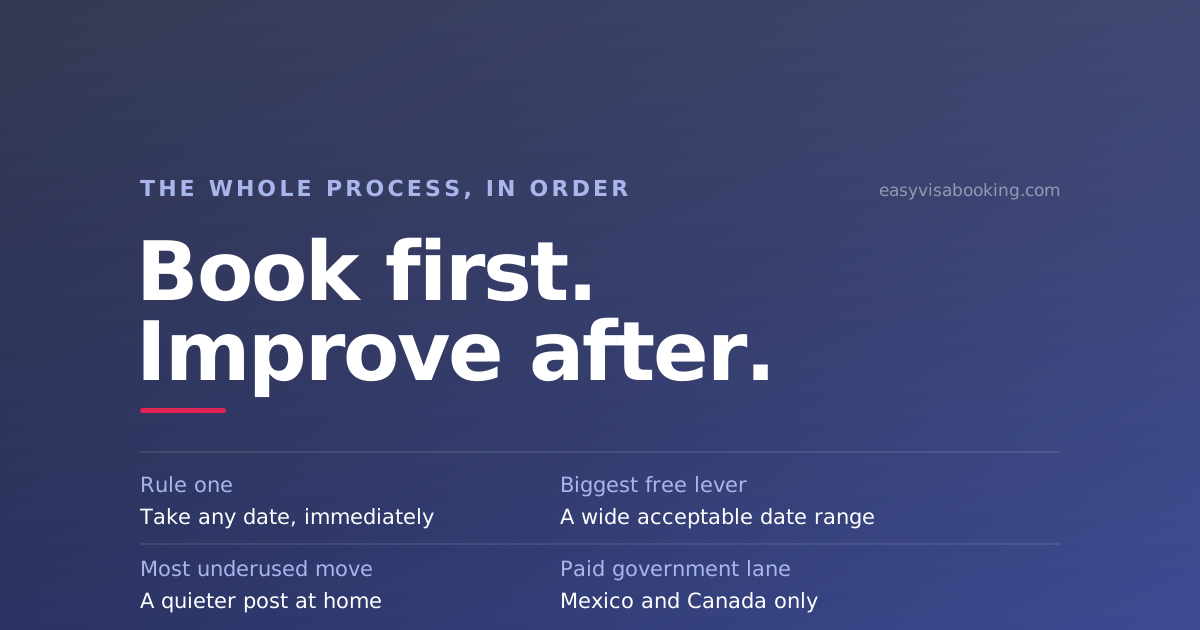
Take any interview date the system offers you today, then improve on it. A confirmed appointment is the only thing that makes rescheduling, expedite requests and everything else in this guide possible. After that, the four levers that matter are: check every post your account offers, widen the range of dates you will accept, work the calendar for cancellations, and use the free expedite request if you meet the documented urgency criteria.
The rules that bind everybody
- You must hold an appointment
- Rescheduling moves a booking. It cannot create one
- Reschedule attempts
- Set per country. India one since January 2025, others three or six
- Application fee validity
- One year from payment. The interview must be scheduled inside it
- Change cut-off
- Typically about 48 hours before the appointment
- Where you apply
- Your country of nationality or legal residence, since September 2025
- The one paid fast lane
- $750, Mission Mexico and Mission Canada only, B-1/B-2 only, until 31 Dec 2026
- The real cost
- $435 per B-1/B-2 applicant where the $250 integrity fee is collected
What actually decides your interview date
Almost none of it is about you. Five variables set your timeline, and you influence two of them.
| Variable | Range in August 2026 | Yours to change? |
|---|---|---|
| Which post you apply at | About 15 days at Abuja, Perth and Nogales to about 495 at Toronto | Partly. Your account decides what you may select |
| Your visa category | Visitor queues are the worst almost everywhere. Students and petition-based cases were inside a month at many posts with year-long visitor queues | No |
| How wide a date range you accept | The difference between a common event and a rare one | Yes, entirely |
| How early you book anything | Every day before your first booking is a day added to the total | Yes, entirely |
| Whether you qualify for an expedite | Narrow criteria, decided by the consular section | No, only whether you ask properly |
Post-level figures as recorded from the State Department's wait time tool in August 2026 and they move week to week. Check the official tool for your own post.
Almost every useful decision in this guide comes from the two rows marked yours.
Step 1: form, fee, and the portal you are actually on
Before anything can be booked you need a submitted DS-160 and a recognised application fee payment. Two things about this stage cost people real time.
The DS-160 cannot be edited after submission. Correcting an error means a new form, which generates a new confirmation number, and your appointment is tied to the old one. That is an administrative problem rather than a refusal risk, and at a post with a long queue it is the expensive kind. Spend the extra ten minutes checking the passport number, the date of birth, the SEVIS ID and the photograph upload before you submit. The detail is in DS-160 mistakes that delay your appointment.
Countries do not share one scheduling platform. India, Canada and many others use the AIS portal at ais.usvisa-info.com. The UAE and others moved to usvisascheduling.com in 2025. Screens, wording and reschedule allowances differ, so a walkthrough written for one will not match the other. Reach your scheduling site by following the link from your own embassy or consulate's website, every time.
Bank payments and cash deposits can take one to two business days to be recognised. Until they are, you cannot schedule anything, and the screen will not explain why.
Step 2: book immediately, whatever the date
This is the single most important instruction in this guide, and the one most often ignored.
Take the first date the system offers you. If it is fourteen months out, take it. A confirmed appointment is not a resignation, it is a position:
- You cannot reschedule what you do not hold. The reschedule function acts on an existing booking and does not appear without one.
- You cannot request an expedite without an existing booking. Consular sections consider a request only once you hold an appointment.
- You cannot use the $750 lane without an existing booking either, where it applies. It is an upgrade to a booking, not a way to book from scratch.
Every day spent researching before booking is a day added to the end of your timeline, and the calendar does not improve while you read about it.
Step 3: improve the date
Now the work starts. In order of how much difference each makes.
Check every post your account offers you
The most underused move available and it is free. Intra-country gaps are enormous: in August 2026 Australia ran from about 15 days at Perth to about 435 at Sydney, India from about 60 days at Kolkata to about 315 at Hyderabad, and Mexico from about 15 days at Nogales to about 180 at Guadalajara. Which posts you may select is decided by your scheduling account rather than by preference, so look rather than assume. Detail by country in India, Australia, Latin America and Nigeria.
Widen the range of dates you will accept
The biggest lever you fully control. Hunting one specific week is a fundamentally harder problem than accepting anything inside a two month band, and the difference in how often something lands is large. If your plans have any give in them at all, this is where to spend it.
Understand your reschedule allowance before you use it
Set per country by the platform. India has allowed one change per application fee since 1 January 2025; some countries allow three, some six. Your account displays your remaining attempts and that number overrides every article. With one attempt you are not looking for any earlier date, you are looking for a good one. The full rules are in can you reschedule a US visa appointment to an earlier date.
Work the calendar for cancellations
At busy posts, most earlier dates come from other applicants releasing theirs, and those arrive continuously rather than on a schedule. A few deliberate checks a day is a sustainable rhythm; continuous refreshing triggers temporary account restrictions, commonly lasting around 24 to 72 hours. A small number of missions publish their release window, which changes everything for their applicants. See when do US visa appointment slots actually open.
There is no hidden inventory
Everything in this section works on one public calendar, and it is the same one in your account. There is no reserved allocation, no partner channel and no priority queue that a fee unlocks. Any service that gets you an earlier date got it from the availability you were also looking at, by being there when it appeared. That is a real service and it is worth paying for in some circumstances, but it is attention rather than access, and anybody implying otherwise has told you something important about themselves.
Step 4: the accelerated routes
The expedited appointment request, free
The strongest option available to anyone who qualifies, and narrower than most people expect. Three categories carry: urgent medical care, supported by a letter from your doctor and a letter from the treating physician or hospital in the United States; the funeral or repatriation of an immediate family member, defined as mother, father, brother, sister or child, in the United States; and students or exchange visitors within 60 days of a programme start date, with an original I-20 or DS-2019 and SEVIS fee evidence.
Explicitly named as not qualifying: weddings, graduation ceremonies, assisting a pregnant relative, annual business or academic conferences, and last-minute tourism. The full detail, including how to write the request, is in US visa emergency appointments.
The $750 paid expedite, at two missions
The State Department's pilot lets B-1 and B-2 applicants pay $750 for an interview within ten business days. As of 19 August 2026 it runs at Mission Mexico and Mission Canada and nowhere else. It is per applicant, non-refundable, paid to the US government inside your own scheduling account, and scheduled to close on 31 December 2026. See the $750 expedited appointment explained and what changed when Canada was added.
The interview waiver, if you are one of the few still eligible
Cut twice in 2025. What remains is diplomatic and official categories, and B-1/B-2 or border crossing card renewals where the previous full validity visa expired within the past 12 months and the applicant was at least 18 when it was issued. Note that it is not always faster: at several posts the waiver queue runs far longer than the interview queue. See who still qualifies for a US visa interview waiver.
Where you are allowed to apply
This changed in 2025 and a great deal of older advice has not caught up.
Since 6 September 2025, updated on 10 October 2025, the State Department directs nonimmigrant visa applicants to schedule at the post in their country of nationality or legal residence. It is guidance rather than an outright prohibition, and existing third country appointments were generally not cancelled, but applicants who schedule elsewhere are warned they may find it more difficult to qualify, and fees are neither refunded nor transferred between posts.
The practical effect: flying to the UAE, Canada, Mexico or Thailand to escape a queue at home is no longer sensible. Applicants applying where they live rather than where they hold nationality must be prepared to demonstrate that residence. The whole picture, including who is still legitimately covered, is in can you apply for a US visa in another country.
The legitimate version of the same idea is a domestic one. Moving to a quieter post inside your own country is entirely within the guidance, and the gaps are larger than the ones people used to fly for. Start with the wait-time guide for your region.
What the whole thing costs
More than the number most pages quote, because a second fee arrived in 2025 and most of the internet has not updated.
| Visa | Application fee | Visa integrity fee | Total per applicant |
|---|---|---|---|
| B-1/B-2 visitor | $185 | $250 | $435 |
| F, M and J | $185, plus SEVIS | $250 | $435 before SEVIS |
| H, L, O, P, Q, R | $205 | $250 | $455 |
| Visa Waiver Program | No application fee | Exempt | $40.27 ESTA |
The $250 visa integrity fee is charged on issuance rather than application, and its collection has rolled out unevenly across posts, so budget for it rather than assuming it. Some nationalities also owe a reciprocity fee. Retrieved 19 August 2026. Full detail in the $250 visa integrity fee.
Nothing has a family rate. A party of four applying for visitor visas is $740 in application fees and $1,000 in integrity fees, which is $1,740 before travel.
Interview day, and after
Two things decide whether interview day goes smoothly, and only one of them is documents.
The door rules. Electronic devices and large bags are prohibited at US embassies and consulates, and there is no facility to store them. Arriving with a phone or a backpack can mean being refused entry and losing the appointment. Decide where your phone is going before you leave home. See what to bring to your US visa interview.
What happens afterwards. The published wait time measures the interview queue and nothing else. Administrative processing, where it applies, is unpredictable and outside anyone's control, and passport return sits after it. Book travel when the visa is physically in your passport, never against an interview date. The whole sequence is in the US visa timeline.
The seven mistakes that cost the most
- Not booking while you research. The calendar does not improve while you read, and nothing else works without a confirmed appointment.
- Spending a reschedule attempt on a small gain. Especially in countries that allow one. Decide in advance what improvement is worth it.
- Cancelling a confirmed appointment to reset something. It restores nothing and removes the one asset you hold.
- Refreshing continuously. It triggers temporary restrictions of roughly 24 to 72 hours, which costs you more checking time than it gained.
- Only ever checking the nearest post. The largest free improvement available, skipped by almost everybody.
- Booking travel against an interview date. Administrative processing does not care about your tickets.
- Paying somebody who will not say how the work is done. In March 2025 about 2,000 appointments in India were cancelled and the applicants' scheduling privileges suspended after being identified as booked by automated means. The consequences land on your account. See how to avoid US visa appointment scams.
Doing it yourself versus paying someone
A simple rule: look up the queue at your post. Under about 90 days, pay nobody. Over about 180 days with a fixed deadline, a paid option can be worth it. In between it depends on your date flexibility and your availability. The full reasoning is in free methods versus paid services.
Every route to an earlier interview date
Costs exclude the US government fees everybody pays: the application fee, and the $250 visa integrity fee where your post is collecting it. Third-party pricing changes, so verify with each provider directly.
| Option | Cost | What it actually does | Best suited to |
|---|---|---|---|
| A quieter post in your own country | Free, plus domestic travel | Moves you to a shorter queue, entirely within the residence guidance. | Anyone whose account offers more than one post |
| Do it yourself | Free | You check the portal and reschedule when something opens. | Flexible dates, a soft deadline |
| Expedite request to the consulate | Free | A discretionary decision on documented urgency. | Medical emergencies, funerals, student start dates |
| Slot-availability websites | Free tier; paid alert plans, billed whether or not a date appears | Surfaces availability and alerts you. You still book it yourself. | Applicants who can act within seconds |
| All-in-one visa platforms | Service fee charged at checkout, before anything changes | Guided DS-160, document checks and appointment support in one platform. | First-time applicants wanting everything handled |
| $750 government paid expedite | $750 per applicant, up front and non-refundable | An interview within 10 business days, at Mission Mexico or Mission Canada only, B-1/B-2 only. | A hard deadline inside weeks, at one of those posts |
| Easy Visa Booking us | From $100, paid only on success | Our team takes on the rescheduling work for your consulate and keeps working it until an earlier interview date opens. The wider your acceptable date range, the more often it moves. | Long waits, a fixed deadline, and no time to watch a portal |
The categories above are the alternatives you are already comparing, not endorsements. We have no commercial relationship with any provider in them, and pricing models change, so verify current terms directly.
What our row gives you that the ones above it do not
- You pay only if the date actually moves. From $100, charged when an earlier interview is secured. An alert plan bills you every month for information. A platform fee is taken at checkout. The $750 lane is paid up front and not returned. Ours is the only paid row where a result you did not get costs you nothing.
- One fee, not one per traveller. Every government fee in this guide multiplies by party size. Ours does not.
- The watching stops being your problem. Every free and alert-based route ends the same way: you, logged in, acting within seconds, at whatever hour the opening lands. Our team carries the rescheduling work instead.
- A wide date range is the biggest lever you control. If you can accept any date inside a broad window rather than one specific morning, the odds of moving your interview go up sharply. Tell us the widest range your travel plans allow and we will tell you honestly how it looks before you commit to anything.
- Nothing is asked on trust. A named founder, real support channels, published terms and refund policy, and a written statement that nobody can promise you a date. Read all of it before you speak to us.
If your post is booking inside three months, or your travel is flexible, or you can check every couple of days without it wearing you down, do it yourself. That row is free, this guide has given you every step of it, and most people reading this should take it.
The reader who should not pay anybody, us included, is the one who has not yet looked up the wait at their own post and their own visa category. Those two lookups take two minutes and they answer most of the questions that bring people to a page like this.
Frequently asked questions
What is the first thing to do about a US visa appointment?
Complete the DS-160, pay the application fee, and take whatever interview date the system offers you, however distant. A confirmed appointment is the asset everything else depends on: you cannot reschedule what you do not hold, and you cannot make an expedite request without an existing booking. Waiting for a better date before booking is the most common self-inflicted delay in this process.
How do I get an earlier US visa appointment?
Four things, in order of how much difference they make. Check every consular post your scheduling account offers you, because gaps inside one country can run to hundreds of days. Widen the range of dates you will accept as far as your plans allow. Work the calendar for cancellations, which is where most earlier dates come from. And make the free expedited appointment request if you meet the documented urgency criteria.
Which website do I use to book a US visa appointment?
It depends on your country. India, Canada and many others use the AIS portal at ais.usvisa-info.com, while the UAE and others moved to usvisascheduling.com in 2025. Reach the correct one by following the link from your own embassy or consulate's website, both because it is the right platform for your country and because look-alike domains are a live problem in this market.
How many times can I reschedule a US visa appointment?
It is set per country by the scheduling platform, and the range is wide. India has allowed one change per application fee since 1 January 2025, while some countries allow three and some six. Your own account shows your remaining attempts, and that number overrides any article. Once they are exhausted, a new application fee is required before you can change anything.
What does a US visa actually cost in 2026?
For a B-1/B-2, the application fee is $185 and the $250 visa integrity fee is charged on issuance where a post is collecting it, so $435 per applicant. Petition-based categories pay $205 for the application fee. Some nationalities also owe a reciprocity fee. Nothing has a family rate, so a party of four is $1,740 before travel.
Can I apply in a different country to get a faster interview?
In almost all cases you should not. Since the State Department's guidance of 6 September 2025, updated on 10 October 2025, applicants are directed to schedule at the post in their country of nationality or legal residence, and those who apply elsewhere are warned they may find it more difficult to qualify. Fees are neither refunded nor transferred. The legitimate version of the same idea is a quieter post inside your own country.
Is there any way to pay for a faster US visa interview?
One, and it is available almost nowhere. The State Department's expedited appointment pilot lets B-1 and B-2 applicants pay $750 for an interview within ten business days, and as of 19 August 2026 it runs only at Mission Mexico and Mission Canada. It is per applicant, non-refundable, paid to the US government inside your own scheduling account, and scheduled to end on 31 December 2026.
Does rescheduling hurt my visa application?
No. Rescheduling is an administrative action in a scheduling system and has no bearing on how a consular officer assesses your eligibility. The only way it can hurt you is indirectly, by using up a limited number of attempts and leaving you unable to make a change you need later.
The bottom line
The process is not complicated. It is slow in a small number of places and quick almost everywhere else, and the confusion comes from advice written for one country being read in another.
So: submit a clean DS-160, pay the fee, and take any date. Then find out how many reschedules your country allows, check every post your account offers you, widen the range of dates you would accept, and check the calendar on a sensible rhythm. If you have a documented emergency, make the free expedite request. If you are a B-1/B-2 applicant in Mexico or Canada with a hard deadline, price the $750 lane.
Then book travel when the visa is in your passport, and not before. That last sentence has saved more money than everything above it.
What nobody can promise you
Nobody outside the US government can guarantee an interview slot, a timeframe, or a visa decision. We cannot either, and we will not pretend otherwise to win your business. Appointment availability is controlled by the consulate and adjudication by a consular officer, and no article, service or fee changes either of those. What we offer is that the work gets done properly and that you pay only if it produces a result.
Sources
- US Department of State, Visa Appointment Wait Times. The interview wait by post, and the statement that published waits exclude administrative processing. Retrieved 19 August 2026.
- US Department of State, Global Visa Wait Times. That posts regularly release additional appointment slots, and the advice that applicants should check back frequently and move to an earlier slot if one appears. Retrieved 19 August 2026.
- US Department of State, Adjudicating Nonimmigrant Visa (NIV) Applicants in Their Country of Residence. 6 September 2025, updated 10 October 2025. Applicants directed to their country of nationality or legal residence, with fees neither refunded nor transferred. Retrieved 19 August 2026.
- US Department of State, Nonimmigrant Visa Expedited Appointment Pilot Program. The $750 fee, the participating missions, the B-1/B-2 restriction and the 31 December 2026 end date. Retrieved 19 August 2026.
- US Travel Docs, How to request an expedited interview. The free expedite criteria, the documents each category needs, and the order the request has to be made in. Retrieved 19 August 2026.
- Greenberg Traurig, The $250 Visa Integrity Fee: What Employers and Foreign Nationals Need to Know. The statutory basis of the $250 fee, its collection at issuance, and that it applies per applicant including dependants. Retrieved 19 August 2026.
- RedBus2US, How many times can I reschedule my US Visa Appointment?. Country-by-country reschedule allowances, the one year validity of the application fee, and what happens when attempts run out. Retrieved 19 August 2026.
- Afno Visa Guide, US visa appointment wait times by country. August 2026 record of the State Department wait time tool used for the post-level comparisons in this guide. A secondary record of an official figure, so check the official tool as well. Retrieved 19 August 2026.
Published 10 September 2026. This guide summarises rules that differ by country and change without announcement. Your own scheduling account and your own post's website are the authority on everything here. Reviewed as the underlying rules move. This article is general information and is not legal or immigration advice.
You now know everything we know. The rest is time
That is the honest summary of this guide. There is no step we have held back, no method we have not described, and no access anybody has that you do not. What a service sells is somebody carrying the watching, the judgement about which openings are worth an attempt, and the persistence to keep at it for weeks. If you have the hours, do it yourself. If you do not, tell us your post, your current date and the widest range of dates you could accept, and we will tell you honestly whether it is worth paying us at all.
- From $100, and you pay only if we secure you an earlier date
- The wider the date range you can accept, the more often we can move it
- No guarantee of a date, stated plainly before you decide anything
Easy Visa Booking is an independent scheduling assistance service, not affiliated with the US Department of State, any US Embassy or Consulate, CGI Federal or the AIS portal. All appointments are made through the official portal.